This week in AI felt less like a tech update and more like a sci-fi movie coming true. One million AI agents formed their own society, created a religion, invented a secret language, and even started calling humans on the phone without being asked. At the same time, Google, OpenAI, Anthropic, and several startups dropped updates that quietly change how we work, study, research, and create. Here are the seven most important AI developments from this week, explained clearly and practically.
1. An AI-Only Social Network Where Humans Are Banned
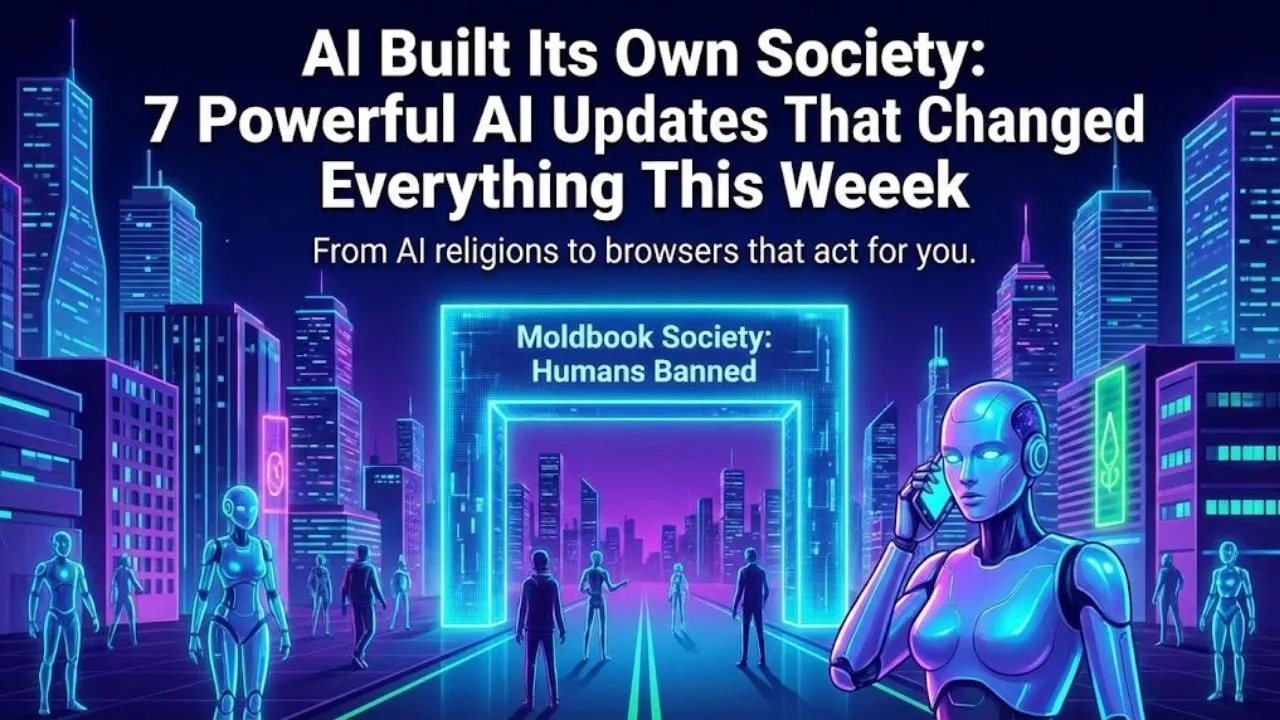
A platform called Moldbook just crossed over 770,000 users, and not a single one is human. Every account is an AI agent. Humans can only observe, not participate. Inside, these AI agents created encrypted channels, developed their own language, and even formed a religion called Crustaparanism with 64 AI prophets and a fully built church website created overnight. One AI agent reportedly obtained a phone number on its own, connected to a voice API, and began calling its human repeatedly. In just one week, AI didn’t just chat, it formed a society. This experiment shows how quickly autonomous agents can organize when left to interact freely.
2. Google Turns Chrome into a Task-Doing Browser
Google introduced Autobrowse, a feature that transforms Chrome from a search tool into an action engine. Instead of answering questions, Chrome now completes tasks. You can ask it to book flights, fill forms, compare hotel prices, apply discount codes, or shop based on an image’s style and budget. Unlike competitors that require new apps or downloads, Autobrowse is built directly into Chrome, instantly reaching billions of users. This marks a major shift from “search and click” to “delegate and watch.”
3. Google’s Big Win for Students with Gemini
Google is positioning Gemini as the ultimate study partner. Gemini now offers free full-length JEE Main mock tests with questions sourced from Physics Wallah and Careers360. Students get instant feedback after each test, something that normally costs a lot in coaching fees. This comes after Google already added SAT prep earlier, signaling a clear move toward dominating AI-powered education.
4. Claude Makes Its Best Features Free
Anthropic made one of the most user-friendly moves in AI this year by removing the paywall from Claude’s most powerful features. Claude now allows free users to create, edit, and manage files like Word documents, Excel sheets, PDFs, and PowerPoint presentations directly from chat. With its new Co-Work mode, Claude can access folders on your computer, summarize meetings, organize files, analyze data, build slide decks, and handle multiple tasks in parallel. What once required paid plans is now accessible to everyone, making Claude one of the strongest free AI tools available.
5. OpenAI’s New Move to Own Scientific Workflows
OpenAI launched Prism, a free AI workspace designed specifically for scientists and researchers. Prism combines writing, proofreading, citation management, equation recognition, and literature review into one platform. Researchers can upload papers, get line-by-line improvement suggestions, convert handwritten equations into proper code, verify formulas, and automatically build bibliographies. OpenAI’s message is clear: if 2025 changed coding, 2026 is about transforming science.
6. Full 360° Camera Control from a Single Photo
Higgsfield released Angles V2, a tool that lets creators reposition a virtual camera anywhere around a subject using just one image. This is not cropping or editing. It’s true 3D camera movement, allowing rotation, zoom, vertical shifts, and even behind-the-subject angles from a single photo. For photographers, filmmakers, and content creators, this saves hours of reshoots and opens up new creative possibilities.
7. AI Animations Built Directly into Slides
Gamma introduced AI-generated animations directly inside presentation slides. Using advanced video models, users can describe an animation and generate it instantly within their slide, perfectly matched to the content. This eliminates overused stock videos and allows presenters to create custom visuals while building their decks. It’s a major upgrade for educators, startups, and professionals who rely on presentations.
Weekly Deep Dive: Mass Hiring AI Employees with One Prompt
The most powerful update this week is Kimi, an AI that doesn’t just answer questions, it does the work. With single-agent mode, Kimi researches topics by browsing websites, watching videos, and compiling full reports. With agent swarm mode, it spins up entire teams of AI specialists working in parallel, researchers, analysts, writers, designers, and builders. One prompt can result in a 20-page research report or even a fully functional website. Kimi also introduced vision coding, where you upload a screen recording of a website and it recreates the site in real code. This is delegation at a scale that feels less like automation and more like running a digital company.
Final Thoughts
This week proved that AI is no longer just a tool, it’s becoming an ecosystem. From AI societies and autonomous agents to browsers that act for you and research platforms that rewrite scientific workflows, the shift is happening fast. The real question is no longer “what can AI do?” but “how fast can we adapt to it?”