The 1950s were a golden age of technological optimism. World War II had ended, the transistor had been invented (1947), and electronics were shrinking while power exploded. Computers were transitioning from room-sized behemoths to something more practical. Amid this excitement, a profound question emerged: Could machines truly think like humans?
Mathematician Alan Turing had already laid the philosophical foundation. In his 1950 paper Computing Machinery and Intelligence, he proposed the famous Turing Test — if a machine could converse indistinguishably from a human, we should consider it intelligent. The stage was set. By 1956, the world would witness the first practical demonstration that machines could reason.
1956: The Logic Theorist – The First AI Program
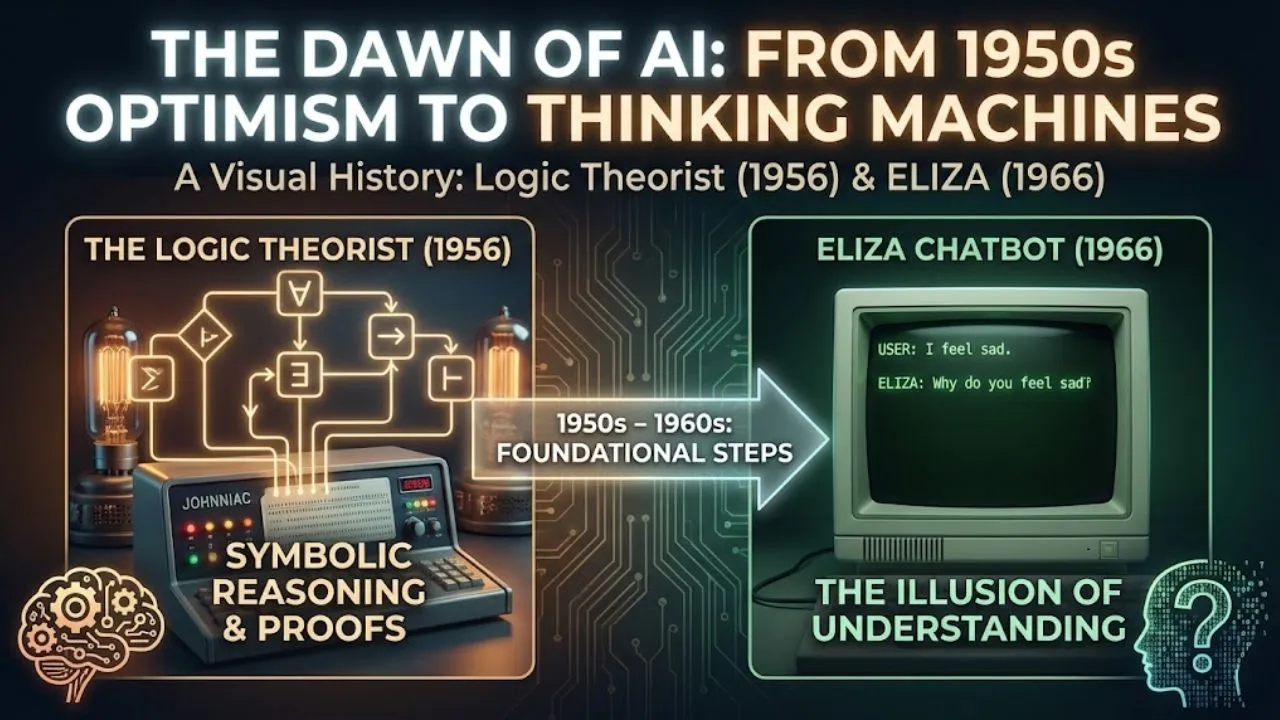
In the summer of 1956, at the historic Dartmouth Conference (where John McCarthy officially coined the term “artificial intelligence”), Allen Newell and Herbert A. Simon (with programmer J.C. Shaw) unveiled the Logic Theorist.
- Purpose: Prove mathematical theorems from Principia Mathematica (Russell & Whitehead, 1910–1913) using human-like logical reasoning.
- Core Innovation: It combined symbolic logic with heuristic search — a tree-search method that used clever shortcuts (heuristics) to prune dead-end paths and focus on promising ones.
- Achievement: Proved 38 of the first 52 theorems in Chapter 2 of Principia Mathematica.
- Mind-blowing moment: For Theorem 2.85, it discovered a shorter, more elegant proof than the one published by Russell and Whitehead — a machine had outperformed the original human authors in creativity within its domain.
Running on the JOHNNIAC computer (a vacuum-tube machine with delay-line memory using mercury-filled tubes for acoustic storage), the Logic Theorist was slow and primitive by today’s standards. Yet it proved a revolutionary point: machines could reason symbolically and discover new knowledge.
This single program ignited the field of symbolic AI (also called Good Old-Fashioned AI or GOFAI) and directly inspired the General Problem Solver (GPS) in 1957–1959.
1966: ELIZA – The First Chatbot and the Illusion of Understanding
Just a decade later, another landmark arrived: ELIZA, created by Joseph Weizenbaum at MIT.
- Purpose: Demonstrate how superficial human-computer conversation could be.
- Technique: Simple pattern matching and keyword substitution — no real understanding, just clever rules.
- Most famous script: DOCTOR — mimicked a Rogerian psychotherapist (non-judgmental, reflective style).
Users typed personal thoughts and feelings. ELIZA responded with open-ended questions like:
- User: “I feel sad today.”
- ELIZA: “Why do you feel sad today?”
People were stunned. Some users formed emotional attachments, confiding deep secrets and fears — even when told it was just a program. Weizenbaum himself was shocked and disturbed by the reactions; he had intended ELIZA as a critique of shallow communication, not a companion.
ELIZA became the ancestor of every modern chatbot, virtual assistant (Siri, Alexa, Grok), and therapy-style AI (like Woebot or Replika). It showed that very little intelligence is needed to create the illusion of deep understanding.
Read Also: The Logic Theorist: The Program That Sparked the AI Revolution
The Pioneers: Driven by a Quest to Understand the Human Mind
Newell, Simon, Weizenbaum, Turing, McCarthy, Minsky, and others weren’t just building tools — they were trying to reverse-engineer human cognition.
- They believed AI was the ultimate scientific instrument for understanding thought, memory, learning, and problem-solving.
- Their work bridged computer science, psychology, philosophy, and linguistics — laying the foundation for cognitive science.
- Techniques born in the 1950s–60s (heuristics, search trees, pattern matching) still underpin modern systems — even if neural networks now dominate headlines.
A Legacy That Still Shapes Our World in 2026
Today we live in the fruit of that early vision:
- Self-driving cars navigate using descendants of heuristic search.
- Large language models carry echoes of ELIZA’s conversational tricks — vastly scaled up.
- Personalized medicine, recommendation engines, and scientific discovery tools all trace roots back to those transistor-era optimists.
The Logic Theorist and ELIZA may look primitive next to GPT-5.3 Codex or Claude Opus 4.6, but they were monumental first steps. They proved machines could:
- Reason symbolically
- Mimic conversation
- Discover elegant solutions
- Create emotional illusions
Most importantly, they ignited a question that still drives us: What does it mean to think — and can we build something that truly does?
The pioneers of the 1950s and 60s didn’t just create programs. They dared to dream that intelligence — human or artificial — could one day be understood, replicated, and perhaps even surpassed.
Their spirit of bold exploration lives on every time we prompt an AI, train a model, or debate whether machines can ever truly “understand.”
Disclaimer: This article draws from well-established AI history sources, including Weizenbaum’s own writings, Newell & Simon’s papers, the Dartmouth Conference records, and standard references (e.g., Pamela McCorduck’s Machines Who Think, 2004; Wikipedia AI timeline; MIT archives). Dates and achievements are based on consensus historical accounts.