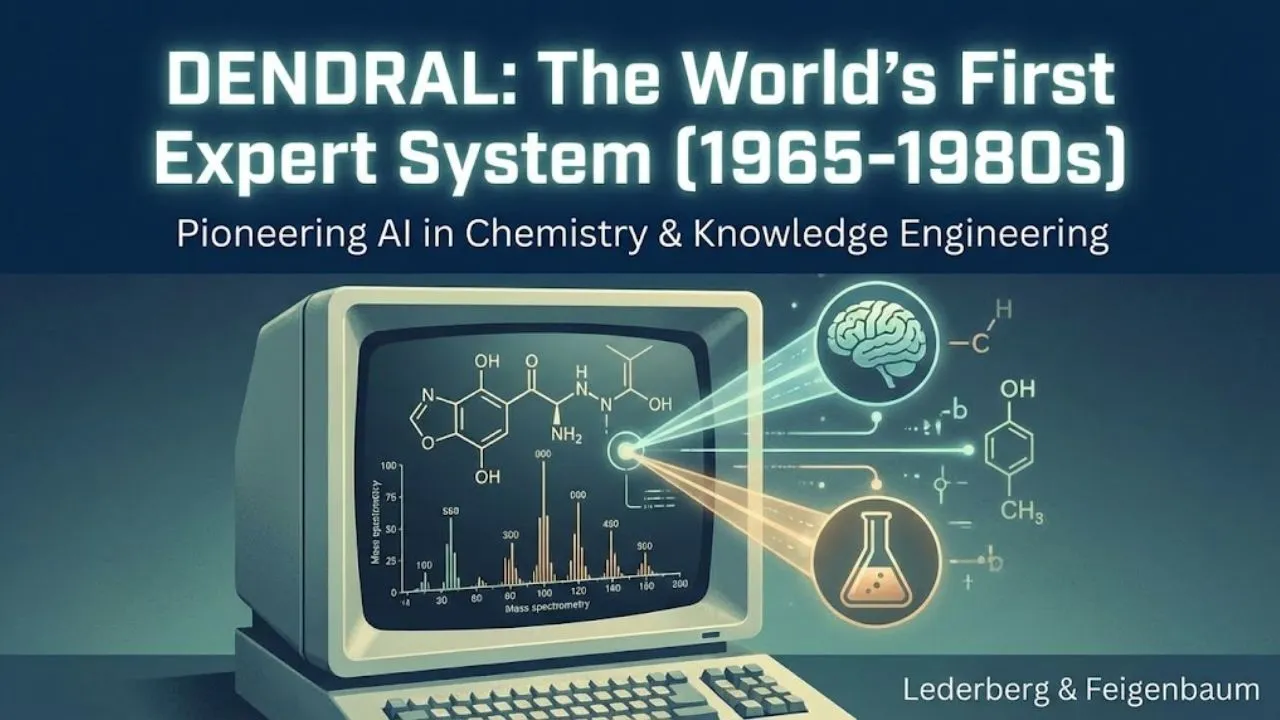
In the mid-1960s, artificial intelligence was still in its infancy — dominated by symbolic reasoning, logic puzzles, and toy worlds like SHRDLU’s blocks. Yet a small team at Stanford University quietly achieved something revolutionary: they built the first true expert system, a program designed to emulate the knowledge and reasoning of human domain experts rather than just solve abstract problems.
That system was DENDRAL (Dendritic Algorithm), launched in 1965 by geneticist Joshua Lederberg (Nobel Prize winner in Physiology or Medicine 1958) and AI pioneer Edward Feigenbaum (often called the “father of expert systems”).
The Vision: Can AI Replicate Scientific Discovery?
The core motivation was ambitious and scientific rather than purely engineering:
- Lederberg and Feigenbaum wanted to understand how scientists form hypotheses and make discoveries.
- Instead of building a general problem solver, they chose a concrete, high-value task: help organic chemists identify unknown molecules from their mass spectra (the pattern of molecular fragments produced when a compound is bombarded with electrons in a mass spectrometer).
Mass spectrometry produces complex fragmentation patterns — peaks at different mass-to-charge ratios (m/z) — that experts interpret using deep chemical knowledge (bond strengths, rearrangement rules, preferred cleavages). Humans could do it, but it was slow, error-prone, and required years of training. Could a computer do it systematically?
How DENDRAL Worked: The First Knowledge-Intensive AI System
DENDRAL combined three key innovations that became the blueprint for all later expert systems:
- Knowledge Base A large, hand-crafted collection of domain-specific rules about organic chemistry:
- Common fragmentation patterns (e.g., loss of methyl, CO, H₂O).
- Substructure constraints (aromatic rings rarely break certain ways).
- Heuristics for likely vs. unlikely ions.
- Inference Engine The program used a generate-and-test paradigm:
- Generator: Produced all plausible molecular structures (candidate graphs) consistent with the molecular formula (from the parent ion peak).
- Tester: Predicted the mass spectrum each candidate would produce if it were the real molecule.
- Evaluator: Ranked candidates by how well the predicted spectrum matched the actual data.
- Heuristics pruned the search space dramatically — without them, the combinatorial explosion of possible structures would be intractable.
- Heuristic Search Early versions used heuristic dendral — rule-based pruning guided by chemical intuition rather than brute force.
The system didn’t just output an answer; in later versions it could explain its reasoning — listing which rules it applied and why certain structures were rejected — a precursor to explainable AI.
The Team Behind DENDRAL
- Joshua Lederberg — Nobel laureate; brought biochemical insight and vision.
- Edward Feigenbaum — AI visionary; led the engineering and knowledge-engineering effort.
- Bruce G. Buchanan — Key architect of the inference engine and rule base.
- Carl Djerassi — World-famous organic chemist (inventor of the birth-control pill); provided domain expertise and validation.
- A talented group of graduate students and research associates who spent years encoding chemical knowledge into rules.
DENDRAL ran for over 15 years, evolving through multiple versions (Heuristic DENDRAL, Meta-DENDRAL for automatic rule learning).
Read Also: The Perceptron: The Simple Building Block That Proved Neural Networks Could Be Universal Computers
Achievements and Impact
- DENDRAL correctly identified many complex organic molecules faster and more consistently than junior chemists.
- It demonstrated that expert-level performance was possible by encoding human specialist knowledge into rules rather than learning from scratch.
- It popularized knowledge engineering — the art of interviewing domain experts and translating their tacit knowledge into explicit rules.
- It directly inspired the expert-systems boom of the 1970s–1980s: MYCIN (medical diagnosis), XCON (computer configuration), Prospector (mineral exploration), and many others.
DENDRAL proved that AI could move beyond puzzles into real-world, high-stakes scientific and industrial problems.
Legacy in 2026
Today expert systems are mostly overshadowed by statistical machine learning and deep neural networks. Yet DENDRAL’s ideas live on in hybrid neuro-symbolic AI:
- Rule-based reasoning in tool-augmented LLMs
- Knowledge graphs + retrieval-augmented generation (RAG)
- Explainable AI efforts that demand interpretable decisions
- Domain-specific AI assistants in chemistry, medicine, and law
Feigenbaum’s famous quote still resonates: “Knowledge is power — in AI, the power comes from the knowledge base.”
DENDRAL wasn’t flashy. It didn’t chat or generate images. But in 1965 it showed the world that AI could think like an expert scientist — and that insight changed everything.
AI truly is the wave of the future — and DENDRAL was one of the first big waves.
Disclaimer: This article is based on historical accounts from Edward Feigenbaum’s writings, Stanford archives, the original DENDRAL papers (1965–1980s), and standard AI history references (e.g., The Sciences of the Artificial by Herbert Simon, Nilsson’s The Quest for Artificial Intelligence). Dates, team members, and achievements reflect consensus records.