Keras is one of the most popular and beginner-friendly libraries for building, training, and deploying deep learning models. It is designed to make deep learning simple, fast, and fun — even if you’re new to machine learning.
In this blog post, we’ll explain exactly what Keras is, why it became so loved, how it works, and why it remains a top choice in 2026 — even after the rise of PyTorch and JAX.
What Exactly Is Keras?
Keras is a high-level neural network API written in Python. It was created by François Chollet in 2015 with one clear goal:
“Make deep learning accessible to everyone — reduce cognitive load, minimize the number of user actions required for common tasks, and provide clear & actionable feedback.”
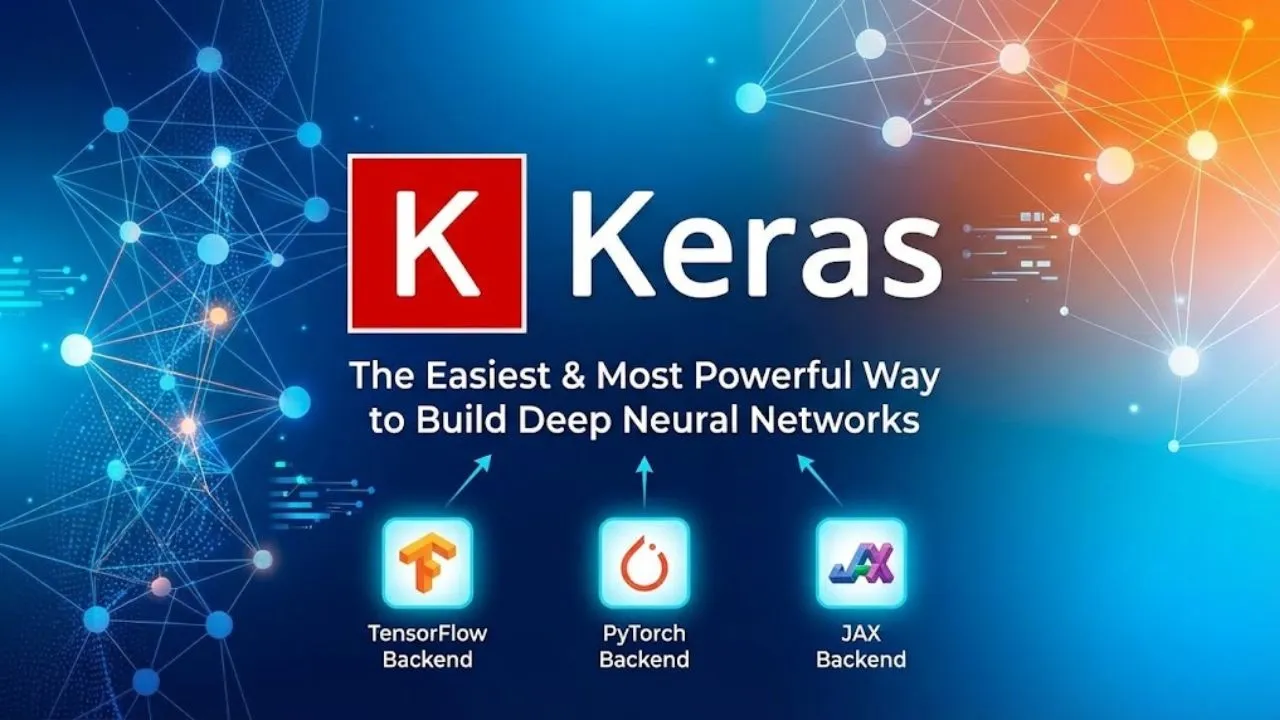
Keras acts like a user-friendly interface on top of lower-level frameworks. You write clean, readable code in Keras — and it runs on top of different backends.
Since Keras 3 (released in 2023–2024), it officially supports multi-backend execution:
- TensorFlow (default)
- PyTorch
- JAX
This means you can write one Keras model and run it on any of these engines without changing a single line of code.
Why Keras Became So Popular
Here are the key reasons Keras is still widely used in 2026:
- Extremely Simple & Readable Code You can define, compile, train, and evaluate a complete neural network in just 5–10 lines.
- Beginner-Friendly No need to manually calculate gradients or deal with graph sessions. Everything is intuitive.
- Productive for Experts Too You can drop down to custom layers, custom training loops, and low-level ops whenever needed.
- Multi-Backend Flexibility (Keras 3) Write once — run on TensorFlow, PyTorch, or JAX. Choose the best engine for your hardware or task.
- Production-Ready Features Built-in support for distributed training, mixed precision, TPU/GPU acceleration, model saving/loading, TensorBoard logging, etc.
- Huge Ecosystem Keras is the default high-level API inside TensorFlow, and it integrates perfectly with Hugging Face, KerasCV, KerasNLP, and many other libraries.
Classic 5-Step Keras Workflow
Almost every Keras model follows these 5 steps:
- Prepare Data Load and preprocess (e.g., normalize images, tokenize text)
- Define the Model Stack layers using Sequential or Functional API
- Compile the Model Choose optimizer, loss function, and metrics
- Train / Fit Run training with .fit() — handles batching, shuffling, validation, callbacks
- Evaluate & Predict Use .evaluate() and .predict() on test data
Simple Example: MNIST Digit Classification (Keras 3 Style)
Python
import keras
from keras import layers
from keras.datasets import mnist

# 1. Load and prepare data
(x_train, y_train), (x_test, y_test) = mnist.load_data()
x_train = x_train.astype("float32") / 255.0
x_test  = x_test.astype("float32")  / 255.0
x_train = x_train[..., None]  # add channel dimension
x_test  = x_test[..., None]

# 2. Build the model
model = keras.Sequential([
    layers.Input(shape=(28, 28, 1)),
    layers.Conv2D(32, 3, activation="relu"),
    layers.MaxPooling2D(),
    layers.Conv2D(64, 3, activation="relu"),
    layers.MaxPooling2D(),
    layers.Flatten(),
    layers.Dense(128, activation="relu"),
    layers.Dropout(0.5),
    layers.Dense(10, activation="softmax")
])

# 3. Compile
model.compile(
    optimizer="adam",
    loss="sparse_categorical_crossentropy",
    metrics=["accuracy"]
)

# 4. Train
model.fit(x_train, y_train, epochs=10, validation_split=0.1)

# 5. Evaluate
test_loss, test_acc = model.evaluate(x_test, y_test)
print(f"Test accuracy: {test_acc:.4f}")
That’s it — a powerful CNN in ~20 lines.
Keras Use Cases in 2026
- Computer Vision — Image classification, object detection, segmentation (KerasCV)
- Natural Language Processing — Text classification, transformers (KerasNLP)
- Time-Series & Tabular Data — Forecasting, anomaly detection
- Generative AI — GANs, diffusion models, fine-tuning LLMs
- Education — Universities and online courses use Keras for teaching deep learning
- Industry — Fast prototyping before moving to production (TensorFlow Serving, TorchServe, etc.)
Read Also: PyTorch: The Pythonic Powerhouse Driving Modern Machine Learning and Deep Learning
Why Choose Keras in 2026?
- You want fast experimentation without boilerplate code
- You need readable, maintainable models for teams
- You want multi-backend flexibility (run the same code on TF, PyTorch, or JAX)
- You are teaching/learning deep learning
- You need strong integration with TensorFlow ecosystem (TPUs, TFX, Vertex AI)
Final Verdict
Keras is not just a library — it’s a design philosophy: Make deep learning simple enough for beginners, powerful enough for experts, and flexible enough for production.
Even if PyTorch dominates research papers, Keras remains one of the fastest ways to go from idea → working model → deployment.
Try it today — install with:
Bash
pip install kerasAnd start building!
Disclaimer: This article is an educational overview of Keras based on official documentation, François Chollet’s writings, and community usage patterns as of February 2026. Features, APIs, and backend support can change with new releases. Always refer to keras.io for the latest tutorials, installation instructions, and release notes.