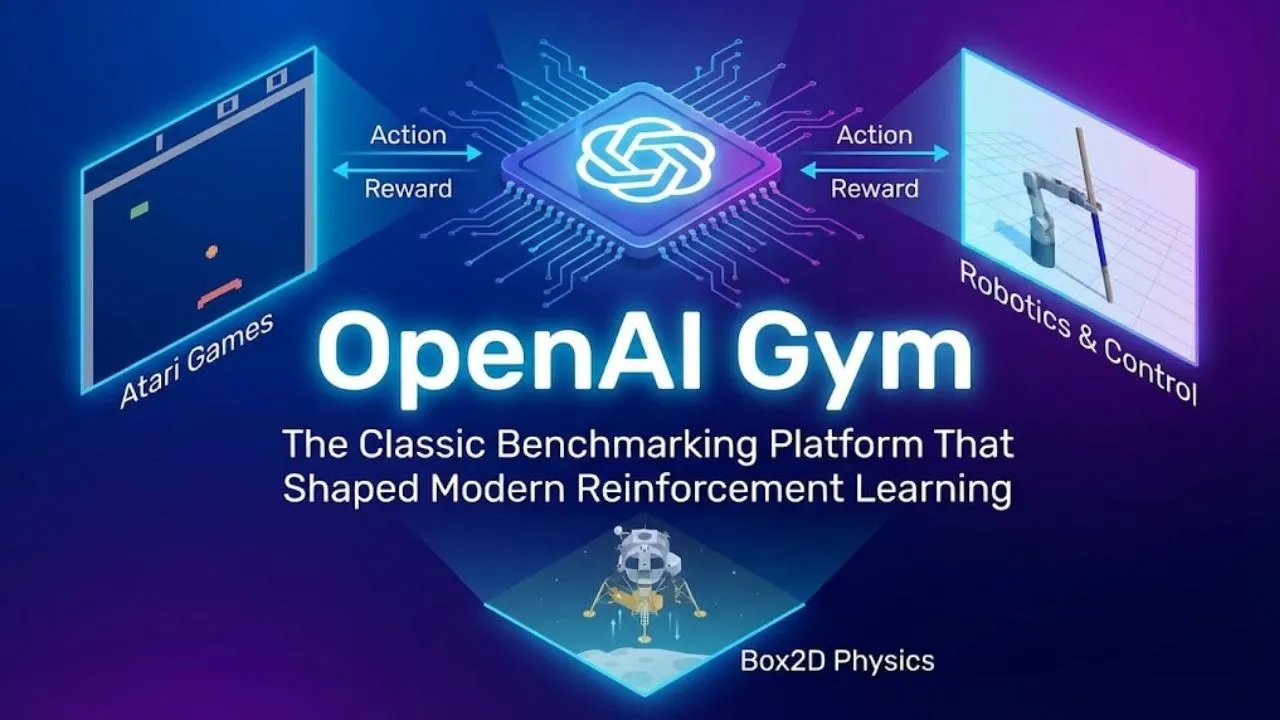
If you’ve ever trained an AI agent to play Atari games, balance a pole, drive a car, walk like a humanoid robot, or land a lunar module, you’ve almost certainly used OpenAI Gym (now simply called Gym).
Launched in April 2016 by OpenAI, Gym quickly became the standard environment suite and benchmarking tool for reinforcement learning (RL) research. Even in 2026 — with far more advanced libraries like Gymnasium, PettingZoo, Procgen, and DM Control — the original Gym remains legendary and is still widely used, cited, and extended.
This blog post explains what Gym is, why it became so influential, how it works, and where it stands today.
What Is OpenAI Gym?
OpenAI Gym is a toolkit for developing and comparing reinforcement learning algorithms. It provides:
- A simple, unified Python API for interacting with many different simulated environments
- A collection of standard benchmark tasks (Atari, classic control, robotics, algorithmic problems)
- Tools for rendering, seeding, and recording episodes
The core idea is: “Write one agent → test it on many standardized environments → compare fairly with published results.”
Gym removed the friction of environment setup so researchers could focus on algorithms.
The Famous Environments (Still Iconic in 2026)
| Category | Famous Environments | Difficulty Level | Why It’s Legendary |
|---|---|---|---|
| Classic Control | CartPole-v1, MountainCar-v0, Acrobot-v1 | Beginner | First environments most people ever solve |
| Atari | Pong, Breakout, SpaceInvaders, Seaquest | Medium–Hard | DeepMind’s DQN paper used these (2015) |
| Box2D Physics | LunarLander-v2, BipedalWalker-v3, CarRacing-v2 | Medium | Continuous control + fun visuals |
| MuJoCo | Humanoid-v4, Hopper-v4, Walker2d-v4 | Hard | Realistic physics, continuous action spaces |
| Algorithmic | Copy-v0, Reverse-v0, Repeater-v0 | Medium | Tests memory & pattern learning |
| Toy Text | FrozenLake-v1, Taxi-v3 | Beginner | Discrete states/actions, great for debugging |
These tasks defined the RL benchmarks for almost a decade.
How Gym Works (Core API)
The API is deliberately simple and elegant:
Python
import gym

# 1. Create environment
env = gym.make("CartPole-v1", render_mode="human")  # or "rgb_array" for recording

# 2. Reset (start new episode)
observation, info = env.reset(seed=42)

done = False
total_reward = 0

while not done:
    # 3. Choose action (your agent’s policy goes here)
    action = env.action_space.sample()           # random action (replace with your policy)

    # 4. Step: execute action, get next state & reward
    observation, reward, terminated, truncated, info = env.step(action)
    done = terminated or truncated
    total_reward += reward

    # Optional: render
    env.render()

print(f"Episode finished with reward: {total_reward}")

env.close()
That’s the entire loop — clean, readable, and consistent across 100+ environments.
Why Gym Was Revolutionary (2016–2020)
- Standardization — Before Gym, every lab used different simulators → impossible to compare papers
- Ease of Use — Install with pip install gym → instant access to dozens of tasks
- Open & Free — Apache 2.0 license, community contributions exploded
- Rendering & Recording — Built-in video saving helped debug and share results
- Seeding & Reproducibility — env.seed(), env.action_space.seed() made experiments repeatable
Gym became the common language of RL research.
Gym in 2026: The Transition to Gymnasium
In 2022, the original OpenAI Gym repository was deprecated and handed over to the community as Gymnasium (gymnasium.farama.org).
Why the change?
- Better long-term maintenance (Farama Foundation)
- Modern API improvements (typed returns, better error handling, updated MuJoCo bindings)
- Removal of deprecated dependencies (e.g., old Box2D)
- Active development (new environments, multi-agent support via PettingZoo integration)
Most papers and code since 2023 use Gymnasium, but:
- The API is almost identical
- pip install gymnasium → gymnasium.make()
- Many older Gym environments still work via gymnasium.envs.register() or compatibility layers
Who Still Uses Gym/Gymnasium Today?
- Education — Almost every RL course starts with CartPole-v1
- Research — Baseline comparisons, prototyping new algorithms
- Industry — Robotics simulation, game AI, autonomous driving prototyping
- Competitions — OpenAI Retro contests, Unity ML-Agents, Google Research Football
Read Also: Keras: The Easiest & Most Powerful Way to Build Deep Neural Networks
Final Verdict
OpenAI Gym (and its successor Gymnasium) didn’t just provide environments — it created a shared benchmark culture that accelerated reinforcement learning progress dramatically.
If you’re learning RL in 2026, start here:
Bash
pip install gymnasium[all] # includes classic control, Box2D, Atari, MuJoCoSolve CartPole → LunarLander → BipedalWalker → your own custom environment. The journey that shaped modern RL begins with one line:
Python
env = gymnasium.make("CartPole-v1")Disclaimer: This article is an educational overview of OpenAI Gym and Gymnasium based on official documentation, GitHub repositories, and historical context as of February 2026. Environment availability, API details, and dependencies can change with new releases. Always refer to gymnasium.farama.org or the original Gym GitHub for the latest installation instructions, environment list, and migration guides.