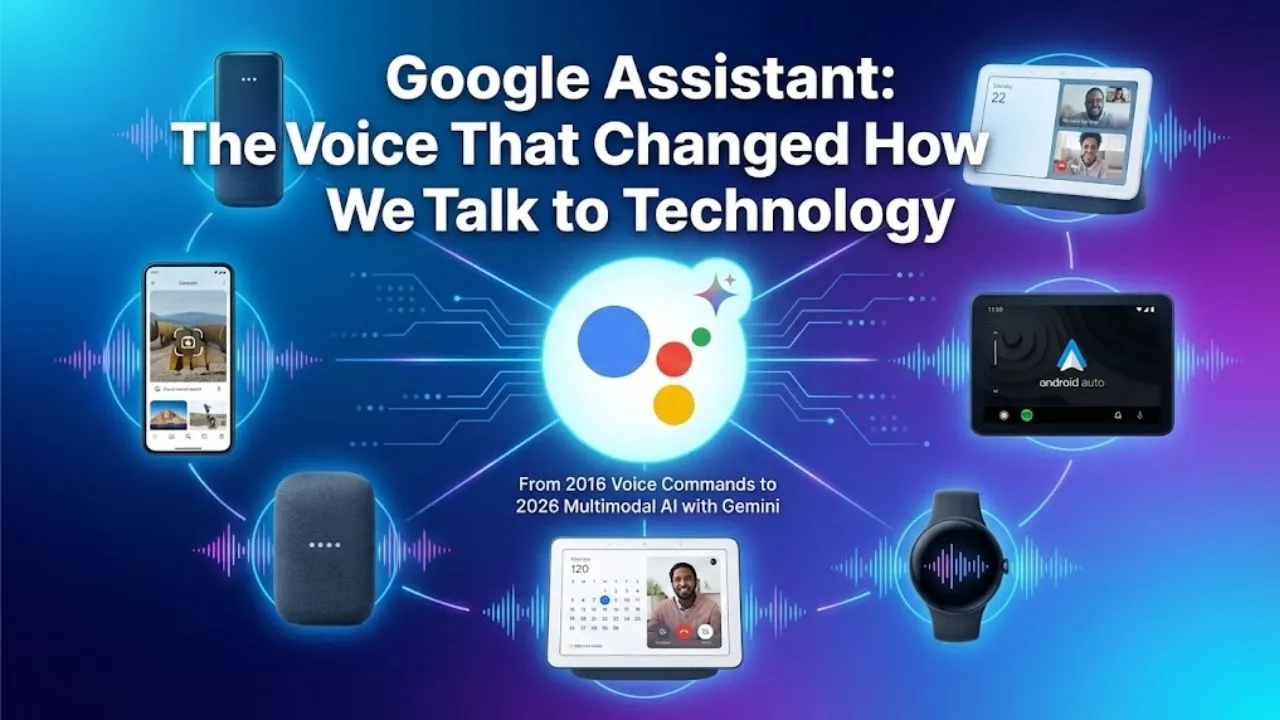
Google Assistant is one of the most widely used virtual assistants in the world. Launched in May 2016, it quickly became the go-to voice-powered AI for Android phones, Google Home speakers, smart displays, cars, headphones, TVs, and even third-party devices. In 2026, it remains a central part of Google’s AI ecosystem — now deeply integrated with Gemini (Google’s advanced multimodal model) and powering billions of interactions every day.
This blog post explains what Google Assistant is, how it evolved, how it works today, and why it still matters in the age of generative AI.
What Is Google Assistant?
Google Assistant is a conversational AI that lets you control devices, get answers, manage your day, and interact with hundreds of services — all using natural language.
You can talk to it by saying:
- “Hey Google”
- “OK Google”
- Long-pressing the home button (on phones)
- Tapping the Assistant icon
It understands context, remembers previous parts of the conversation, and handles follow-up questions naturally.
A Quick Timeline of Google Assistant
- 2016 — Launched on Google Pixel phones and Google Home speaker
- 2017 — Expanded to iOS, third-party speakers (Sonos, JBL), and Android Auto
- 2018–2019 — Added routines, continued conversation, interpreter mode, and smart home control
- 2020–2022 — Voice Match improvements, Nest Hub Max integration, live captioning, and better multilingual support
- 2023–2024 — Integration with Bard → Gemini, multimodal understanding (see + talk), on-device Gemini Nano for privacy
- 2025–2026 — Deeper Gemini 2.0 / 2.5 Flash integration, real-time screen understanding, proactive suggestions, and stronger agentic capabilities (multi-step task planning)
Read Also:- Keras: The Easiest & Most Powerful Way to Build Deep Neural Networks
How Google Assistant Works in 2026
Modern Google Assistant is powered by a hybrid architecture:
- On-device processing (Gemini Nano)
- Handles simple commands offline (set alarms, timers, send texts)
- Fast, private, works without internet
- Cloud processing (Gemini models)
- Complex reasoning, multi-step tasks, web searches, creative answers
- Multimodal: understands images, screenshots, videos, documents
- Key Technologies Under the Hood
- Automatic Speech Recognition (very accurate multilingual)
- Natural Language Understanding (context, intent, entities)
- Dialog Management (continued conversation, reference resolution)
- Text-to-Speech (WaveNet / Neural2 voices — extremely natural)
- Gemini multimodal reasoning (see what’s on your screen + answer questions)
Everyday Things You Can Do with Google Assistant
- Personal Productivity “Remind me to call Mom at 7 PM” “What’s on my calendar tomorrow?” “Add milk and bread to my shopping list”
- Smart Home Control “Turn off the bedroom lights” “Set thermostat to 22 degrees” “Show me the front door camera”
- Information & Search “What’s the weather like this weekend?” “Translate ‘I love you’ to Spanish” “How many goals did Messi score last season?”
- Multimodal & Screen-Aware (2026) “What am I looking at?” (point camera at object) “Summarize this article on my screen” “Add these flight options to my calendar”
- Entertainment & Fun “Play my Discover Weekly playlist” “Tell me a joke” “Sing me Happy Birthday”
Why Google Assistant Still Matters in 2026
- Massive Reach — Available on billions of Android devices, Google Nest speakers, Wear OS watches, Android Auto, smart TVs, etc.
- Multimodal Advantage — Gemini gives it strong vision + language understanding (see + talk + reason)
- Privacy Focus — On-device processing for many tasks, Voice Match, and clear delete controls
- Ecosystem Integration — Works seamlessly with Google Maps, YouTube, Gmail, Calendar, Photos, Nest, Fitbit, and third-party Actions
- Agentic Evolution — Can now perform multi-step tasks (e.g., “Book me a table for 4 at an Italian restaurant near me tonight and text the reservation to my wife”)
Read Also: IBM Watson: The Supercomputer That Made AI Feel Truly Intelligent
Final Thoughts
Google Assistant started as a voice assistant that could set timers and play music. Today it’s a multimodal, proactive, agentic companion that sees your screen, understands your world, plans multi-step actions, and helps you get things done — often before you even finish asking.
In a world full of chatbots and voice AIs, Google Assistant remains one of the most accessible, reliable, and deeply integrated options — especially if you already live in the Google ecosystem.
Try saying “Hey Google, tell me something interesting” right now — you might be surprised how far it’s come.
Disclaimer: This article is based on publicly documented features, historical milestones, and current capabilities of Google Assistant and Gemini as of February 2026. Features, voice models, multimodal abilities, and integrations can change with software updates. Always check support.google.com/assistant or blog.google for the latest information.