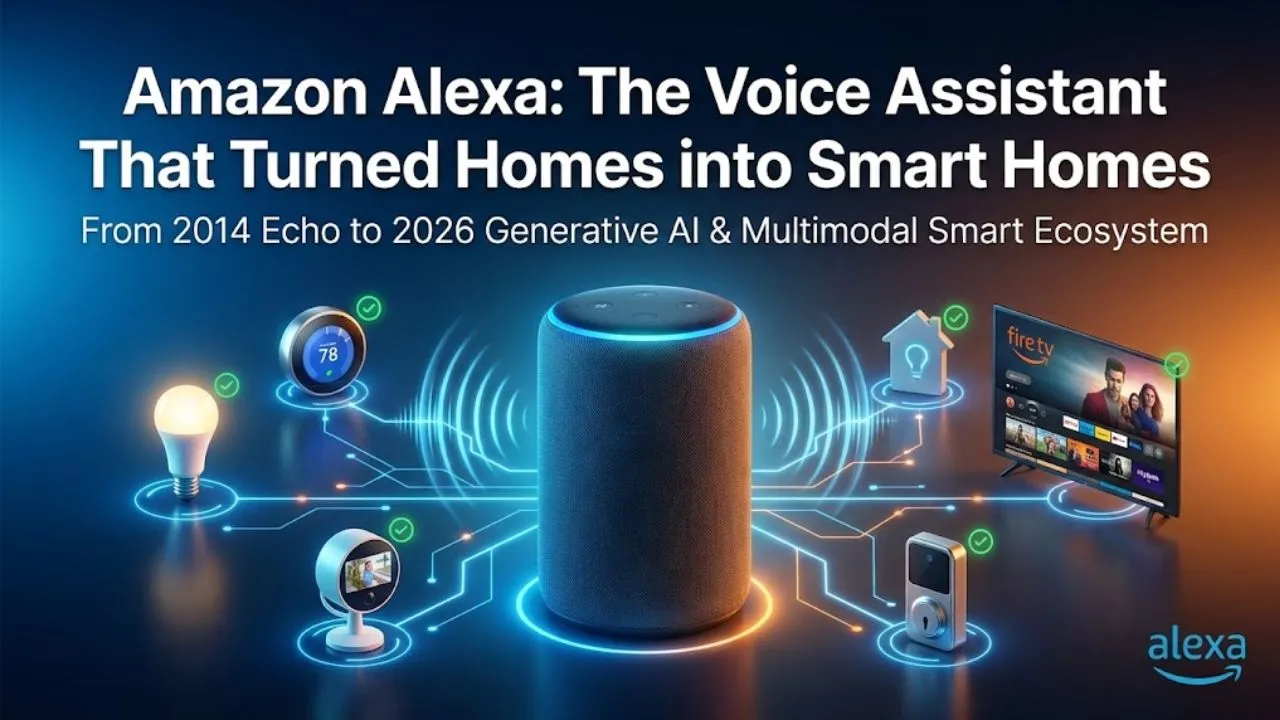
Amazon Alexa is one of the most recognizable names in consumer artificial intelligence. Launched in November 2014 with the first Echo smart speaker, Alexa quickly became the world’s most popular voice assistant — powering smart homes, controlling entertainment, answering questions, managing daily tasks, and integrating with millions of devices worldwide.
In 2026, Alexa remains a central part of Amazon’s AI strategy, now supercharged with generative AI, multimodal understanding, and deeper integration across Echo devices, Fire TV, Ring cameras, Astro robots, cars, and third-party hardware.
This blog post covers everything you need to know about Alexa: its history, how it works, key features, real-world impact, and where it stands today.
The Birth of Alexa (2014–2016)
Amazon unveiled Alexa in 2014 as the voice behind the Amazon Echo — a black, cylindrical smart speaker that listened for the wake word “Alexa” and responded to natural-language commands.
Early killer features:
- Play music from Amazon Music, Spotify, Pandora
- Set timers and alarms
- Read news, weather, sports scores
- Control smart lights (Philips Hue), thermostats (Nest), and plugs
By 2016, Alexa had overtaken competitors in smart-speaker market share and opened the Alexa Skills Kit — allowing third-party developers to create custom voice experiences (Skills).
How Alexa Works in 2026
Modern Alexa combines several layers of technology:
- Wake Word Detection (on-device) Always-listening neural network detects “Alexa” (or custom wake words) locally — no audio is sent to the cloud until triggered.
- Automatic Speech Recognition (ASR) Converts spoken audio → text (very accurate, multilingual, handles accents and noise well).
- Natural Language Understanding (NLU) Understands intent (“play jazz”, “turn off bedroom lights”, “what’s the news?”) and extracts entities (song name, room name, time).
- Generative AI & Reasoning (2024–2026) Powered by Amazon’s large language models (Titan, now deeply integrated with generative capabilities) Handles follow-up questions, context, multi-step tasks, humor, and creative responses.
- Multimodal & Vision (2025+) Echo Show, Echo Spot, and newer devices use cameras + Gemini-like multimodal models to “see” what you point at or what’s on screen.
- Smart Home Hub Built-in Zigbee, Matter, Thread, Sidewalk support — acts as a central hub for lights, locks, cameras, sensors.
- Privacy Controls Voice history auto-delete (3/18 months), manual delete, physical mic/camera off buttons, voice match for personalization.
Everyday Things You Can Do with Alexa
- Smart Home Control “Alexa, good morning” → turns on lights, reads news, starts coffee machine “Alexa, lock the doors and arm security”
- Entertainment “Alexa, play my Discover Weekly” “Alexa, show me funny cat videos on Fire TV”
- Productivity “Alexa, add eggs and bread to my shopping list” “Alexa, set a reminder for doctor appointment at 3 PM tomorrow”
- Information & Fun “Alexa, what’s the capital of Mongolia?” “Alexa, tell me a dad joke” “Alexa, translate ‘I love you’ to French”
- Multimodal (Echo Show & newer devices) “Alexa, what am I looking at?” (point camera at plant, book, object) “Alexa, summarize this recipe on my screen”
- Routines & Hunches Proactive suggestions: “It’s getting dark — should I turn on the porch light?” Multi-device routines triggered by time, location, voice, or sensors
Read Also:- TextCortex – The AI Writing & Knowledge Assistant That Works Across Your Apps in 2026
Alexa Skills & Third-Party Ecosystem
The Alexa Skills Kit lets developers build voice experiences:
- Banking (check balance, pay bills)
- Food delivery (Domino’s, Zomato)
- Fitness (track workouts)
- Games & trivia
- Smart home brands (Philips Hue, Ring, Ecobee, August Locks)
In 2026, many skills now use generative AI to provide more dynamic, conversational responses.
Alexa vs. Competitors in 2026
| Feature | Alexa | Google Assistant | Siri |
|---|---|---|---|
| Smart Home Market Share | Largest (Matter + Zigbee hub) | Strong (Thread support) | Growing (HomeKit focus) |
| Generative AI Depth | Very strong (Titan + gen AI) | Excellent (Gemini) | Improving (Apple Intelligence) |
| Multimodal (Vision) | Strong on Echo Show | Very strong | Limited |
| Third-Party Skills/Actions | 100,000+ Skills | Actions on Google | Shortcuts/App Intents |
| On-Device Processing | Good | Excellent (Gemini Nano) | Very strong |
| Ecosystem Lock-in | Amazon devices + services | Google services | Apple devices |
Why Alexa Still Matters
- Massive installed base — hundreds of millions of Echo devices worldwide
- Smart home leadership — built-in Zigbee, Matter, and Sidewalk make it a true hub
- Generative upgrade — now handles complex, multi-step requests and creative responses
- Privacy improvements — on-device wake word, auto-delete options, clear controls
- Everywhere presence — phones, TVs, cars, headphones, microwaves, clocks, glasses
Read Also: Google Assistant: The Voice That Changed How We Talk to Technology
Final Thoughts
Alexa started as a simple voice speaker that played music and set timers. Today it’s a multimodal, proactive, generative AI companion that sees your home, understands your requests, controls your devices, and helps you get things done — often before you finish speaking.
In the era of agentic and multimodal AI, Alexa remains one of the most accessible and deeply integrated voice assistants — especially if you live in an Amazon-powered home.
Try saying “Alexa, introduce yourself” on any Echo device — you’ll hear how far voice AI has come.
Disclaimer: This article is based on publicly documented features, historical milestones, and current capabilities of Amazon Alexa as of February 2026. Voice models, multimodal abilities, privacy controls, and integrations can change with software updates. Always check amazon.com/alexa or the Alexa app for the latest information.