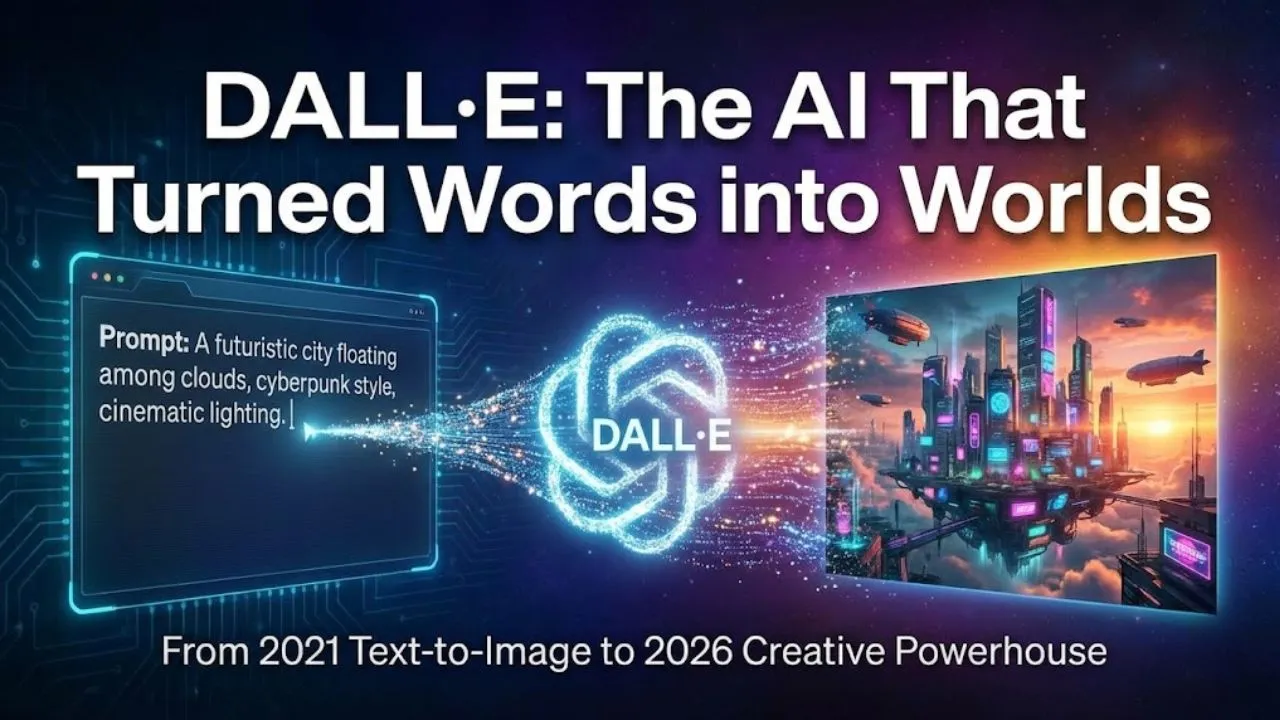
DALL·E is one of the most iconic names in the history of generative artificial intelligence. Developed by OpenAI, it showed the world — for the first time at scale — that a machine could generate highly creative, photorealistic, or surreal images directly from natural language descriptions. From “a cat astronaut riding a rocket on Mars” to “a cyberpunk city at night in the style of Van Gogh,” DALL·E made the impossible visual in seconds.
This blog post covers everything you need to know about DALL·E: its history, how each version improved, how it works, real-world impact, current status in 2026, and why it still matters.
The Evolution of DALL·E (Timeline)
| Version | Release Date | Key Capabilities | Resolution & Style Quality | Public Access |
|---|---|---|---|---|
| DALL·E | January 2021 | 12-billion-parameter model, text-to-image generation | 256×256 pixels, good but limited detail | Limited beta (waitlist only) |
| DALL·E 2 | April 2022 | Much higher fidelity, inpainting, outpainting, variations | 1024×1024, photorealistic & artistic styles | Public via OpenAI API + web interface |
| DALL·E 3 | October 2023 | Deeper text understanding, better prompt following, ChatGPT integration | 1024×1024 & 1792×1024 (wide), excellent coherence | ChatGPT Plus / API (widely used today) |
| DALL·E 4 (rumored/early 2026) | Early 2026 (speculative) | Expected: native video generation, stronger 3D consistency, real-time editing | 2048×2048+, video clips | Likely deeper ChatGPT / Sora integration |
Note: As of February 2026, DALL·E 3 remains the publicly available version integrated into ChatGPT, while OpenAI has shifted focus toward multimodal reasoning (GPT-4o, o1 series) and video (Sora). DALL·E 3 is still the go-to text-to-image model for most users.
How DALL·E Works (Simplified)
DALL·E combines two powerful ideas:
- Diffusion Models (the core engine since DALL·E 2)
- Starts with pure noise
- Gradually removes noise step-by-step until a clear image appears
- Conditioned on text prompt via CLIP embeddings
- CLIP (Contrastive Language–Image Pretraining)
- A joint vision-language model trained on 400 million image-text pairs
- Understands the meaning of words and connects them to visual concepts
- Helps DALL·E “know” what “cyberpunk samurai” or “melting clock in desert” should look like
DALL·E 3 further improved this by:
- Better prompt rewriting (turns vague user inputs into detailed descriptions)
- Stronger alignment with user intent
- Reduced artifacts and better text rendering inside images
Read Also:- Elon Musk Just Revealed xAI’s Master Plan – And It Goes Far Beyond Chatbots
Iconic Features & Capabilities
- Text-to-Image Generation — Describe anything → get a unique image
- Image Variations — Upload a photo → generate similar but different versions
- Inpainting & Outpainting — Edit or extend existing images
- Style Control — “in the style of Studio Ghibli”, “oil painting”, “low-poly 3D”, “cinematic lighting”
- High Resolution — Up to 1792×1024 natively (DALL·E 3)
- Text in Images — Much better at spelling and coherent text (logos, posters, book covers)
- ChatGPT Integration — Type a prompt in ChatGPT → instantly generate images
Real-World Impact & Use Cases (2026)
- Marketing & Advertising — Create instant campaign visuals, product mockups, social media assets
- Game & Concept Art — Rapid character design, environment concepts, UI mockups
- Education — Visualize historical scenes, scientific concepts, storybook illustrations
- Product Design — Prototype packaging, fashion, furniture, architecture renders
- Content Creation — YouTube thumbnails, blog headers, NFT art, meme generation
- Film & Storytelling — Storyboard generation, mood boards, pre-visualization
- Accessibility — Generate visual descriptions for blind/low-vision users
Strengths & Limitations in 2026
Strengths
- Extremely high-quality and coherent outputs
- Best-in-class prompt following (especially DALL·E 3)
- Seamless ChatGPT integration — conversational image creation
- Strong safety filters (blocks harmful content)
- Affordable pricing via ChatGPT Plus / API
Limitations
- Still generates only static images (no native video — that’s Sora’s domain)
- Occasional artifacts in complex hands, text, or multi-character scenes
- Rate limits and cost for heavy API usage
- Less “raw creative freedom” than some open-source models (Midjourney, Flux, Stable Diffusion 3)
Where to Use DALL·E Right Now
- Easiest way: ChatGPT (Plus / Team / Enterprise) — just type your prompt
- API: developers.openai.com — integrate into apps, websites, workflows
- Free tier: Very limited (few images per month via ChatGPT free plan)
Read Also: Amazon Alexa: The Voice Assistant That Turned Homes into Smart Homes
Final Thoughts
DALL·E didn’t just create images — it democratized visual creativity. Before 2021, making high-quality custom art required years of skill or expensive software. Today, anyone can describe an idea in plain English and get a professional-looking result in seconds.
In 2026, DALL·E (especially version 3) remains one of the most reliable, coherent, and accessible text-to-image models — particularly when used through ChatGPT. It may not have the raw customization of open-source alternatives, but its prompt understanding, safety, and seamless integration keep it at the top for most everyday and professional use cases.
Want to try it? Open ChatGPT right now and type: “Generate an image of a futuristic city floating among the clouds at sunset, cyberpunk style, cinematic lighting.”
You’ll see why DALL·E changed everything.
Disclaimer: This article is based on publicly documented history, features, and capabilities of DALL·E models as of February 2026. Image quality, pricing, safety policies, resolution options, and API availability can change with new releases. Always refer to openai.com/dall-e, platform.openai.com, or the ChatGPT interface for the latest information.