AutoGPT is widely considered the first viral autonomous AI agent — a tool that made headlines in 2023 by showing the world what happens when you give a large language model (like GPT-4) the ability to think for itself, break down goals, create tasks, execute them, self-correct, and keep going until the objective is complete — all without constant human input.
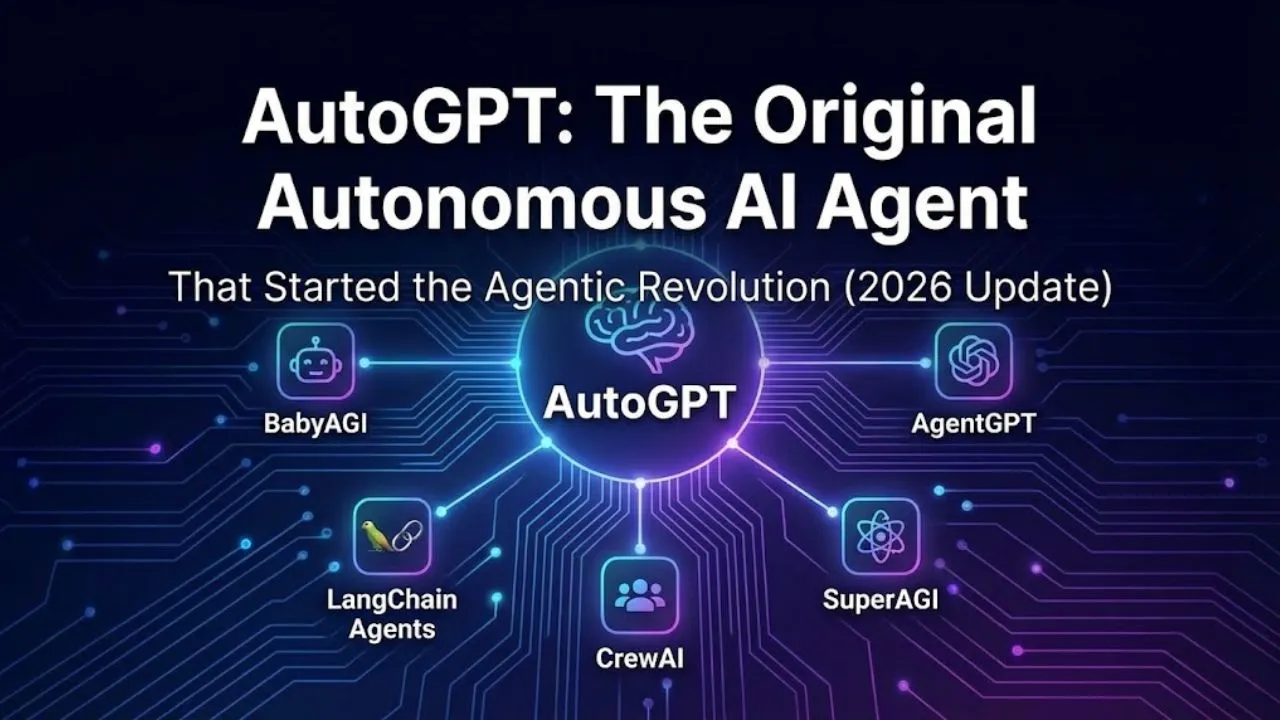
Even in 2026, AutoGPT remains one of the most influential open-source projects in the agentic AI space. While newer frameworks (BabyAGI, LangChain Agents, CrewAI, SuperAGI, AgentGPT, GodMode, etc.) have built on its ideas and often surpassed it in usability and reliability, AutoGPT is still the spiritual ancestor of almost every serious autonomous agent tool today.
Here’s a clear, up-to-date look at AutoGPT in February 2026 — what it actually is, how it works, why it exploded in popularity, its current state, and why many developers still fork and experiment with it.
What Is AutoGPT?
AutoGPT is an open-source Python application that turns a powerful LLM (originally GPT-4, now compatible with GPT-4o, Claude 3.5, Gemini, Grok, Llama 3.1, etc.) into a self-directed agent.
You give it one high-level goal (e.g., “Research the best electric cars under $50,000 in 2026 and write a comparison report”), and AutoGPT does the rest:
- Breaks the goal into sub-tasks
- Creates a to-do list
- Executes each task (web search, file writing, code running, etc.)
- Self-critiques its own output
- Adjusts plans if stuck
- Continues until it believes the goal is achieved (or hits limits)
It runs in a loop: Think → Plan → Act → Observe → Repeat.
How AutoGPT Works (Simplified Architecture)
- User Goal → You set the objective and any initial context
- Task List → AutoGPT generates and prioritizes sub-goals
- Tools Access → It can use:
- Web search (via DuckDuckGo, Serper, Tavily, etc.)
- File read/write
- Code execution (Python interpreter)
- Browser automation (Selenium)
- Memory (short-term + long-term vector DB)
- Self-Prompting Loop AutoGPT constantly asks itself:
- What is my current task?
- What do I need to do next?
- Did the last action succeed?
- What should I do if I’m stuck?
- Output → Final deliverables (report, code, files, research summary)
Classic example prompt that went viral in 2023: “Create a marketing plan for a new AI-powered productivity app targeting freelancers.”
AutoGPT would:
- Research competitors
- Analyze target audience
- Draft blog post ideas
- Write ad copy
- Suggest pricing
- Output a full plan
Why AutoGPT Exploded in 2023–2024
- Zero-shot autonomy — no need for manual chaining of prompts
- Open-source (MIT license) — anyone could fork, improve, run locally
- Viral demos — people posted insane results on Twitter/X, Reddit, YouTube
- Inspiration for dozens of forks → BabyAGI, GodMode, AgentGPT, SuperAGI, MetaGPT, CrewAI, etc.
AutoGPT in 2026 – Current State & Reality Check
The original AutoGPT repo (Significant-Gravitas/AutoGPT) is still active but no longer the bleeding edge. Here’s what actually changed:
- Best Current Fork: Many developers now use AutoGPT-Next or AutoGPT-Fork repositories (faster, better tool integration, support for Claude 3.5 / Gemini 2.0 / Grok 3)
- Local & Privacy-Focused: You can run AutoGPT completely offline with local models (Llama 3.1 70B, Mixtral 8x22B, Gemma 2, etc.) via Ollama or LM Studio
- Better Tool Ecosystem: Modern forks integrate Tavily, Exa, Serper, Browserless, Playwright, and even custom APIs
- Memory Improvements: Vector databases (Pinecone, Chroma, Weaviate) for long-term memory — original AutoGPT struggled with context loss
- UI Wrappers: Projects like AutoGPT WebUI, GodMode.space, AgentGPT make it usable without terminal
Real-World Use Cases in 2026
- Market Research — “Analyze top 10 AI tools in productivity category” → full report with sources
- Content Pipelines → “Create 10 blog post ideas → write outlines → draft 3 articles”
- Business Planning → “Build a go-to-market strategy for a SaaS app”
- Coding Prototypes → “Generate a full React + Node.js todo app with auth”
- Personal Automation → “Plan my week based on my calendar and goals”
Strengths & Limitations
Strengths
- True autonomy — minimal human intervention
- Fully open-source & local-run possible
- Huge community forks & improvements
- Inspires almost every modern agent framework
Limitations
- Original repo is slow & memory-hungry on large tasks
- Can get stuck in loops or hallucinate plans
- High API cost if using paid models (GPT-4o, Claude)
- Requires technical setup for best results (unless using wrappers)
Read Also: Notion AI: The AI That’s Quietly Transforming How Millions Work Inside Notion (2026 Overview)
Final Verdict
AutoGPT in 2026 is not the most polished or fastest agent tool anymore — CrewAI, LangGraph, AutoGen, and Claude’s own agents often outperform it in usability and reliability.
But AutoGPT is still the original spark — the project that proved autonomous agents were possible and inspired an entire industry.
If you want to:
- Understand how agents really think
- Run fully local/private agents
- Experiment with the raw philosophy of goal-driven AI
…then forking AutoGPT (or using a modern wrapper) remains one of the best ways to learn and build.
Quick start in 2026: Clone a maintained fork → install via Docker or Python → set your API key (or local model) → give it a goal like: “Research the best AI writing tools in 2026 and write a comparison blog post.”
Watch it think, plan, search, write — and you’ll see why AutoGPT changed AI forever.
What’s your experience with AutoGPT or other agents? Share in the comments!
Disclaimer: This article is based on the original AutoGPT project, active forks, community usage patterns, and industry observations as of February 2026. Performance, stability, API costs, and model compatibility can vary greatly depending on fork, local setup, or cloud LLMs used. Always refer to github.com/Significant-Gravitas/AutoGPT or popular forks for the latest code, setup guides, and safety notes.