AI Technology

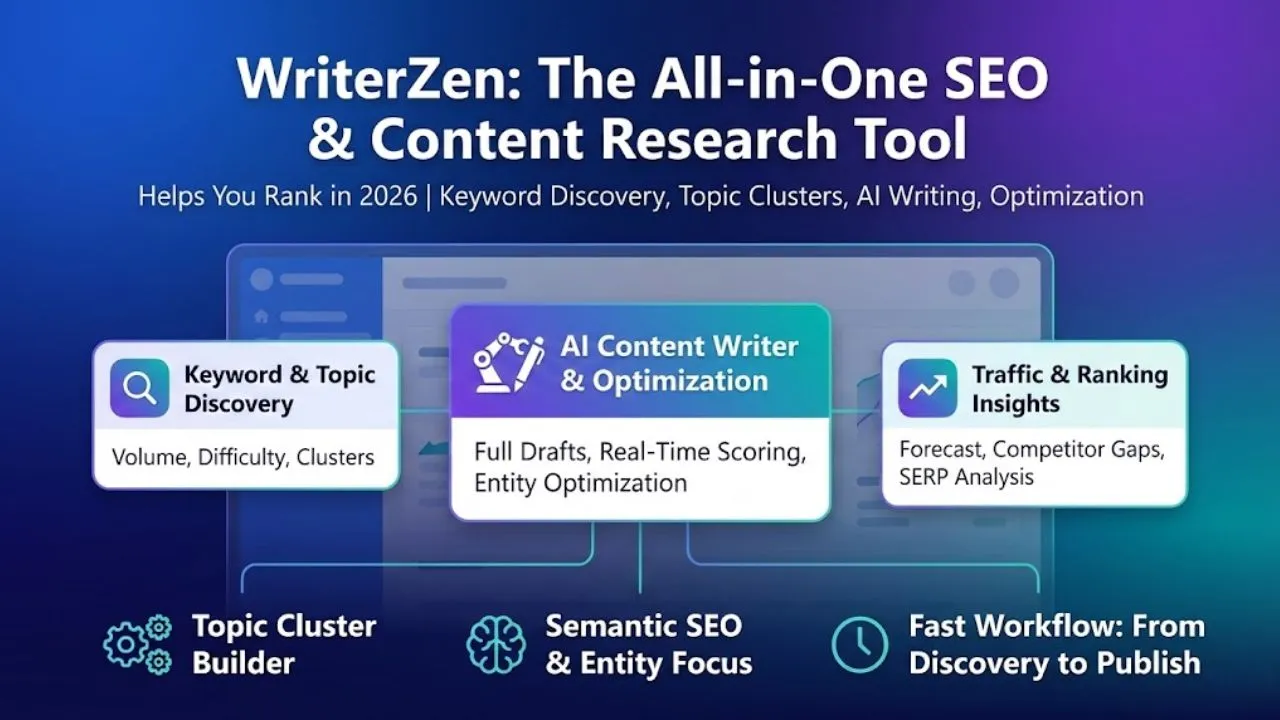
Scalenut AI 2026 – SEO content platform with Cruise Mode, keyword clustering, live SEO score, traffic prediction, and AI blog writing

Scalenut – The AI SEO & Content Creation Tool That Helps You Rank Higher in 2026

Scalenut is one of the most complete AI-powered SEO and content marketing platforms available today. It combines keyword research, content planning, AI writing, on-page optimization, SERP analysis, and traffic prediction — all inside one dashboard. While most AI writing tools focus only on generation, Scalenut is built for ranking content on Google — helping bloggers, […]

Scalenut – The AI SEO & Content Creation Tool That Helps You Rank Higher in 2026 Read Post »

Anyword AI 2026 – marketing copy tool with predictive performance scoring, brand voice training, A/B variants, and ad optimization

Anyword – The AI Copywriting Tool That Predicts Performance Before You Publish in 2026

Anyword is one of the most data-driven AI copywriting platforms available today. Unlike general-purpose tools that just generate text, Anyword was built specifically for marketers who want copy that actually converts — blog headlines, Facebook ads, email subject lines, landing pages, product descriptions, social posts, and more. What makes Anyword stand out in 2026 is

Anyword – The AI Copywriting Tool That Predicts Performance Before You Publish in 2026 Read Post »

Sudowrite AI 2026 – creative writing assistant for novelists, screenwriters, fanfiction; Story Engine, Describe tool, Canvas, Story Bible

Sudowrite – The AI Writing Partner Built Specifically for Fiction Writers in 2026

Sudowrite is widely considered the best AI tool ever made for creative fiction writers — novelists, short-story authors, screenwriters, fanfiction creators, and anyone who writes narrative prose. While most AI writing tools focus on marketing copy, blogs, or social media, Sudowrite is laser-focused on storytelling: helping you beat writer’s block, expand scenes, generate ideas, deepen

Sudowrite – The AI Writing Partner Built Specifically for Fiction Writers in 2026 Read Post »

Elicit AI interface showing academic paper search, table extraction of study data, PDF analysis, and AI-powered literature review assistant

Elicit – The AI Research Assistant That’s Quietly Becoming Essential for Academics and Scientists in 2026

Elicit (elicit.com) is one of the most focused and genuinely useful AI tools built specifically for academic and scientific research. While most people use ChatGPT or Claude for general questions, Elicit is designed from the ground up to help researchers, students, professors, PhD candidates, and R&D professionals find, understand, and synthesize academic papers faster than

Elicit – The AI Research Assistant That’s Quietly Becoming Essential for Academics and Scientists in 2026 Read Post »

perceptron neural network diagram single artificial neuron nand gate example

The Perceptron: The Simple Building Block That Proved Neural Networks Could Be Universal Computers

The perceptron is one of the earliest and most elegant ideas in artificial neural networks. Introduced by Frank Rosenblatt in 1958 (and implemented on the Mark I Perceptron computer), it is essentially a single artificial neuron that makes a binary decision: yes/no, 0/1, fire/don’t fire. Despite its simplicity, the perceptron revealed something profound: networks of

The Perceptron: The Simple Building Block That Proved Neural Networks Could Be Universal Computers Read Post »

early question answering systems baseball lunar shrdlu symbolic ai abbott and costello problem

The “Good Old Days” of Question Answering: BASEBALL, LUNAR, SHRDLU, and the Abbott & Costello Problem

Long before large language models could answer almost any question with near-human fluency, question-answering (QA) systems were narrow, rule-based, and domain-specific. In the 1960s and early 1970s — the golden age of symbolic AI — researchers built impressive but brittle natural-language interfaces to structured knowledge. These systems worked beautifully within their tiny worlds… and failed

The “Good Old Days” of Question Answering: BASEBALL, LUNAR, SHRDLU, and the Abbott & Costello Problem Read Post »

early artificial intelligence history logic theorist 1956 eliza chatbot 1966 alan turing symbolic ai pioneers

The Dawn of AI: From the 1950s Optimism to the Birth of Thinking Machines

The 1950s were a golden age of technological optimism. World War II had ended, the transistor had been invented (1947), and electronics were shrinking while power exploded. Computers were transitioning from room-sized behemoths to something more practical. Amid this excitement, a profound question emerged: Could machines truly think like humans? Mathematician Alan Turing had already

The Dawn of AI: From the 1950s Optimism to the Birth of Thinking Machines Read Post »

The Logic Theorist The Program That Sparked the AI Revolution

The Logic Theorist: The Program That Sparked the AI Revolution

Ever wondered where artificial intelligence truly began? While modern AI powers chatbots, image generators, and self-driving cars, the story starts much earlier—in the mid-1950s—with a program called the Logic Theorist. Widely regarded as the first deliberately engineered AI program, it proved machines could simulate human-like reasoning and problem-solving. Developed by Allen Newell, Herbert A. Simon,

The Logic Theorist: The Program That Sparked the AI Revolution Read Post »

Scroll to Top