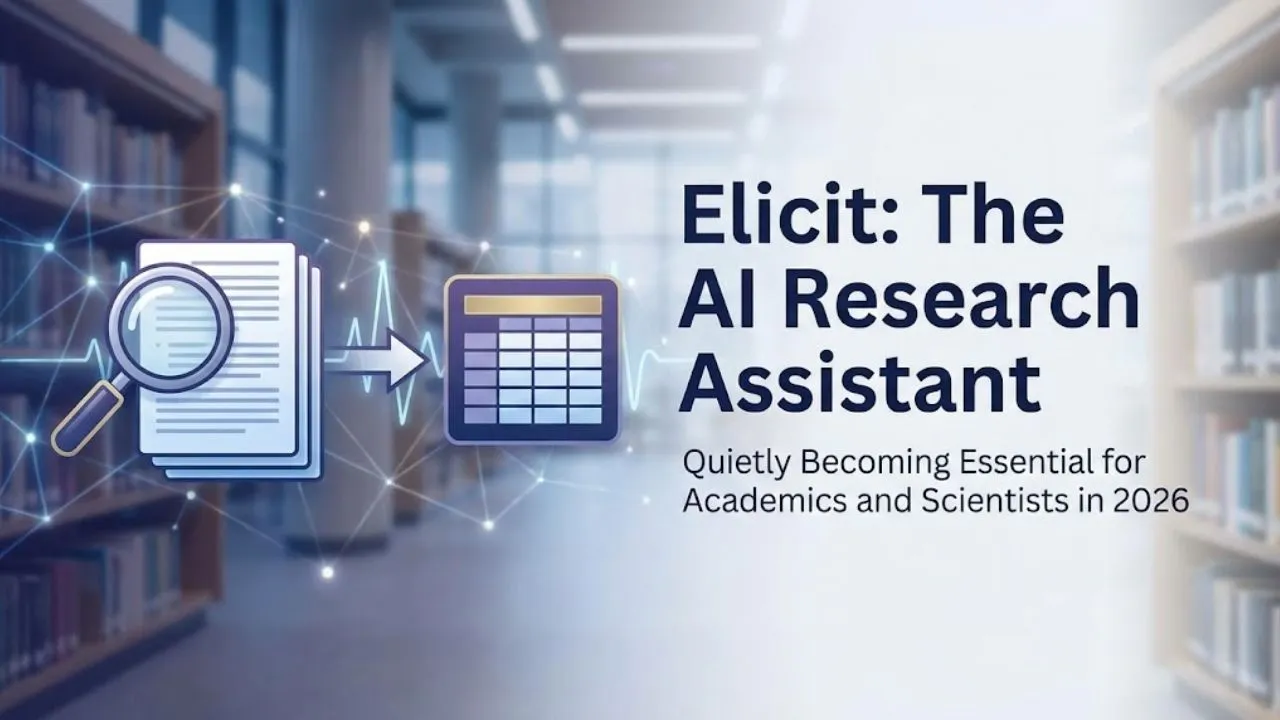
Elicit (elicit.com) is one of the most focused and genuinely useful AI tools built specifically for academic and scientific research. While most people use ChatGPT or Claude for general questions, Elicit is designed from the ground up to help researchers, students, professors, PhD candidates, and R&D professionals find, understand, and synthesize academic papers faster than any traditional search or manual reading ever could.
In early 2026 Elicit remains one of the strongest “research copilot” tools — especially for anyone who regularly reads, summarizes, or extracts insights from scholarly literature. Here is the complete overview – including features most people still don’t fully realize or use.
What Elicit Actually Does
Elicit is not a general chatbot. It is an AI research assistant that works directly on academic papers.
You give it a research question or topic, and Elicit:
- Searches 125+ million academic papers (Semantic Scholar corpus + other sources)
- Finds the most relevant papers (even if they don’t contain your exact keywords)
- Extracts key information (methods, results, sample size, intervention, outcome, etc.) into clean tables
- Summarizes abstracts or full papers
- Answers targeted questions across multiple papers
- Suggests follow-up questions and related work
- Helps brainstorm research directions, hypotheses, or gaps
Core Features That Make Elicit Special (2026)
| Feature | What It Does in 2026 | How Useful Is It? | Still Underused? |
|---|---|---|---|
| Semantic Paper Search | Finds relevant papers even without exact keyword matches | Extremely accurate for niche topics | No – core strength |
| Table Extraction | Pulls methods, results, sample sizes, p-values, etc. into tables | Saves 5–10 hours per literature review | Yes – massive time-saver |
| Question Answering Across Papers | “What is the effect size of X intervention on Y outcome?” → answers from 10–50 papers | Precise & sourced | Yes – game-changer |
| Paper Summaries | One-click summary of abstract or full PDF (if uploaded) | Very reliable & concise | Yes – daily use |
| Brainstorm & Research Gaps | “What are open questions in federated learning 2026?” → suggests directions | Helps find novel research ideas | Yes – very powerful |
| Upload Your Own PDFs | Upload papers → ask questions about them | Works great on paywalled or unpublished work | Yes – huge for PhDs |
| Export & Citation | One-click export to CSV, BibTeX, RIS | Perfect for Zotero/Mendeley users | Yes – workflow win |
Hidden / Lesser-Known Strengths
- Table Extraction Is Shockingly Accurate Elicit reads full PDFs (not just abstracts) and pulls structured data (sample size, p-value, confidence intervals, intervention details) into neat tables. This alone can replace 5–10 hours of manual Excel work per literature review.
- “Find Concepts” Mode Ask “What machine learning methods are used for protein folding?” → it clusters concepts across hundreds of papers and shows which methods appear most.
- Research Gap & Hypothesis Suggestions After reviewing 20–50 papers → ask “What are the biggest open questions?” or “Suggest novel research directions” → it gives surprisingly good ideas (often better than junior PhD brainstorming).
- Free Tier Is Actually Usable Free users get ~20–50 searches/month + basic table extraction. Many students and early-career researchers stay free forever.
- PDF Upload Works on Scanned/Old Papers Upload scanned PDFs or old papers → Elicit OCRs them reasonably well and extracts tables/methods.
Pricing & Access (Early 2026)
- Free
- ~20–50 searches/month
- Basic table extraction & summaries
- No advanced export
- Plus (~$12–15/month)
- Unlimited searches
- Full table extraction on hundreds of papers
- PDF upload & analysis
- Export to CSV/BibTeX
- Pro / Team (~$49+/month)
- Unlimited + team workspaces
- Priority support
- Advanced filtering & bulk export
Most researchers go Plus — unlimited searches make it worth the price.
Real-World Use Cases in 2026
- Literature Reviews → “Find all RCTs on metformin for PCOS 2015–2026” → table of methods/results
- PhD & MSc Students → Summarize 50 papers → extract gaps → suggest thesis directions
- Grant Proposals → “What are the current challenges in federated learning for healthcare?” → quick background section
- Systematic Reviews → Table of effect sizes, sample sizes, p-values across studies
- Interdisciplinary Research → “Compare ML methods in climate modeling vs. drug discovery”
- Teaching & Lectures → Generate summary slides from 20 papers
Read Also:- Phind – The Developer-First AI Search Engine That Still Feels Like a Secret Weapon in 2026
Strengths & Limitations
Strengths
- Highest accuracy for academic & scientific questions
- Best table extraction & structured data from papers
- Real citations & low hallucination on research topics
- Very strong PDF upload & analysis
- Affordable Plus plan
Limitations
- Weaker at non-academic creative writing vs. Claude
- No native image/video generation
- Less personality/flair than Grok or Character.AI
- Free tier quite limited for heavy use
- Still can miss very niche or very recent preprints
Final Verdict
Elicit is not a general-purpose chatbot — it is the best AI research assistant for academic and scientific work.
If your daily work involves:
- Reading, summarizing, or extracting data from papers
- Doing literature reviews, systematic reviews, or meta-analyses
- Finding research gaps or novel directions
- Working with PDFs and tables
…then Elicit is still one of the strongest specialized tools in 2026 — often saving weeks of manual work.
Quick test you can do right now: Go to elicit.com → ask: “What are the main findings from the top 10 RCTs on semaglutide for weight loss published 2020–2026? Show in table with sample size, duration, effect size.”
You’ll see why researchers quietly rely on it every day.
What’s your favorite Elicit use case or workflow? Share in the comments!
Disclaimer: This article is based on Elicit’s publicly available features, search corpus, extraction accuracy, and researcher-reported patterns as of February 2026. Paper coverage, table accuracy, and plan limits can change with updates. Always refer to elicit.com for the latest capabilities, pricing, and terms.