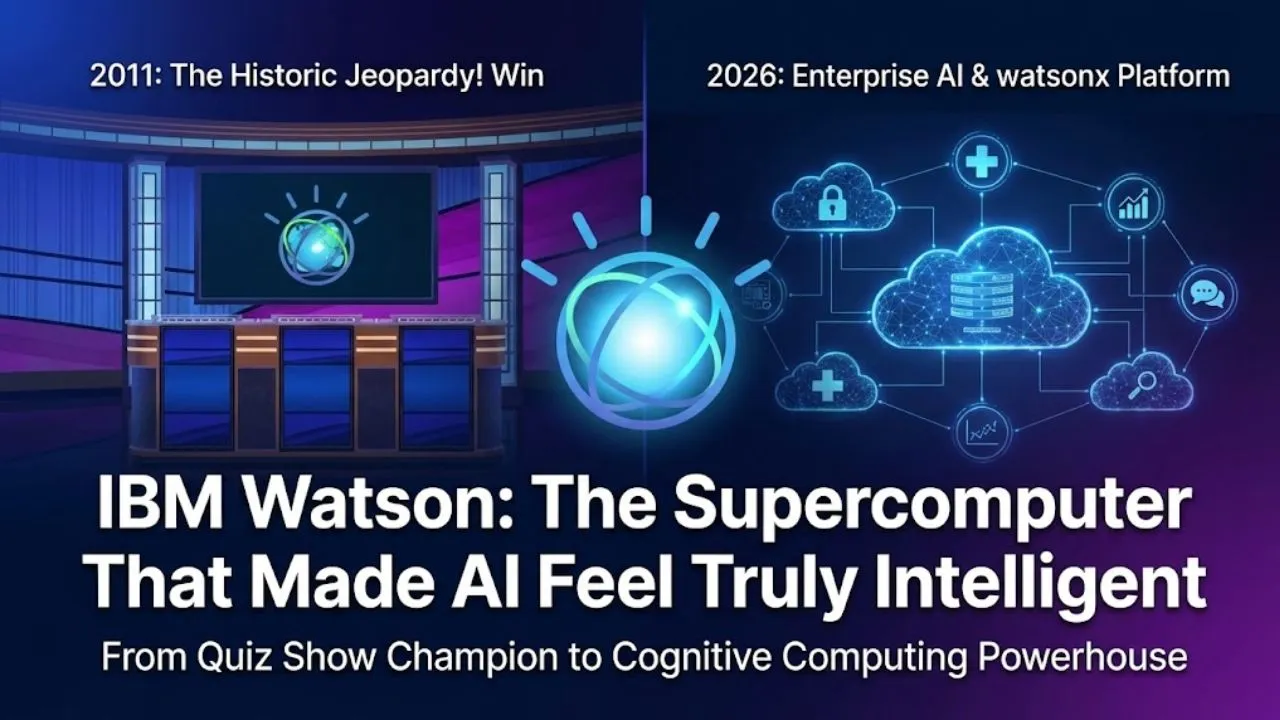
IBM Watson is one of the most famous names in the history of artificial intelligence. In 2011, it shocked the world by defeating human champions on the American quiz show Jeopardy!. Since then, Watson has evolved from a game-playing machine into a powerful suite of AI technologies used in healthcare, finance, customer service, and many other industries.
In this blog post, we’ll explain in simple language what IBM Watson is, how it works, why it became so famous, and where it stands today in 2026.
What Is IBM Watson?
IBM Watson is not just one computer — it is a family of AI services and platforms developed by IBM. At its core, Watson is a cognitive computing system designed to understand natural language, reason, learn from data, and provide human-like answers or recommendations.
Key point: Watson was built to handle unstructured data (80% of the world’s data), such as news articles, research papers, blogs, tweets, PDFs, emails, and medical records — things that traditional databases can’t easily process.
The Historic Jeopardy! Moment (2011)
In February 2011, Watson competed on Jeopardy! against two of the show’s greatest champions: Ken Jennings and Brad Rutter.
- Watson won the two-game match convincingly, earning $1 million.
- It answered complex, tricky questions with puns, metaphors, and clues in natural language — something no computer had done before at that level.
This victory proved that machines could understand context, ambiguity, and human-like reasoning — not just calculate numbers or follow strict rules.
How Does Watson Work?
Watson uses a combination of advanced AI technologies:
- Natural Language Processing (NLP) Understands questions written in everyday human language (English, Spanish, etc.).
- Information Retrieval Searches massive amounts of unstructured data (Wikipedia, medical journals, enterprise documents) in milliseconds.
- Machine Learning & Ranking Algorithms Generates hundreds of possible answers → scores and ranks them based on confidence → picks the best one.
- Hypothesis Generation & Evidence For every answer, Watson provides supporting evidence (source documents) so users can trust the decision.
- Deep Learning & Neural Networks Later versions added modern deep learning models (CNNs, transformers) for better accuracy.
In short: You ask a question → Watson reads millions of documents → ranks thousands of possible answers → returns the most confident answer with proof.
Read Also: Kafkai AI – The Niche Content Generator That’s Still a Hidden Gem for SEO Writers in 2026
Real-World Applications of IBM Watson (2026)
Watson is no longer just a quiz-show champion. Today it powers serious business and scientific solutions:
- Healthcare
- Watson Health (oncology, drug discovery, clinical trial matching)
- Analyzes patient records, research papers, and guidelines to support doctors
- Finance & Banking
- Fraud detection, risk assessment, customer service chatbots, compliance monitoring
- Customer Service
- Watson Assistant — virtual agents that understand natural conversation (used by banks, airlines, telcos)
- Supply Chain & Manufacturing
- Predictive maintenance, quality control, demand forecasting
- Legal & Research
- Analyzes contracts, case law, patents, and scientific literature
Why Watson Was Revolutionary
- It showed the world that AI could understand context and ambiguity
- It handled unstructured data at massive scale
- It introduced explainable AI — Watson always shows its sources and confidence score
- It proved cognitive computing could solve real human problems
Read Also: OpenAI Gym: The Classic Benchmarking Platform That Shaped Modern Reinforcement Learning
Watson Today (2026)
IBM has shifted focus:
- watsonx — the modern AI & data platform (includes watsonx.ai, watsonx.data, watsonx.governance)
- Integrates generative AI (LLMs), foundation models, and enterprise-grade governance
- Supports hybrid cloud, open-source models, and strong data privacy
Watson technology now lives inside watsonx and powers many IBM Cloud services.
Final Thoughts
IBM Watson started as a supercomputer that beat humans at Jeopardy! — but it became much more: a symbol of how AI can understand, reason, and assist humans in complex real-world tasks.
From healthcare to banking to customer support, Watson (and now watsonx) continues to help organizations make smarter decisions with massive amounts of messy, real-world data.
If you want to see AI that feels truly “intelligent,” Watson was one of the first machines to make that dream real.
Disclaimer: This article is an educational overview of IBM Watson based on its historical achievements (Jeopardy! 2011), official IBM documentation, and publicly available information as of February 2026. The original Watson system has evolved significantly into the watsonx platform. Features, services, and capabilities may have changed. Always refer to ibm.com/watson or ibm.com/watsonx for the latest details.