RapidMiner is one of the most established and widely used platforms for data science, machine learning, and AI development — especially among enterprises, analysts, educators, and teams that want to move fast without writing thousands of lines of code.
Originally launched in 2001 as “YALE” (Yet Another Learning Environment) by a group of German researchers, it evolved into RapidMiner and has since become a go-to solution for organizations that need production-grade predictive analytics, AutoML, and AI workflows with strong governance and explainability.
What Makes RapidMiner Different?
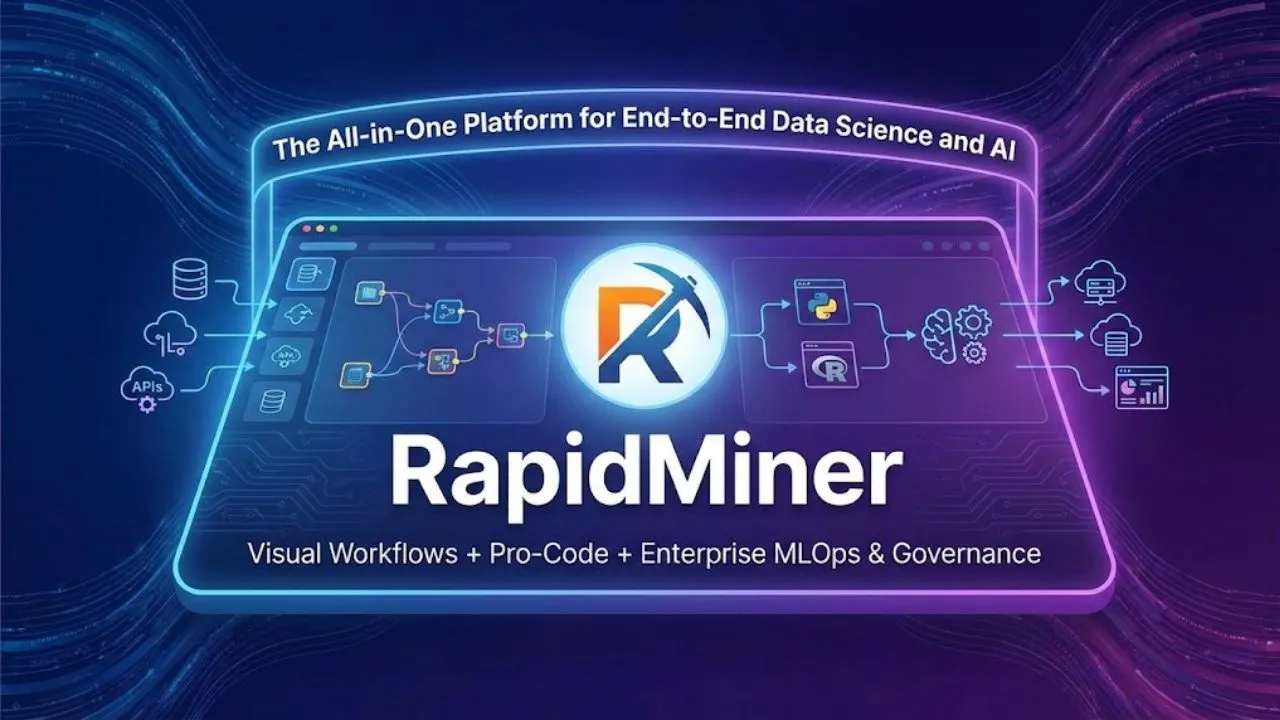
RapidMiner combines three worlds in a single platform:
- Visual drag-and-drop workflow designer (no-code / low-code)
- Full Python / R / Java extensibility (pro-code when needed)
- Enterprise-grade execution, governance, and deployment (MLOps + collaboration)
This hybrid approach lets business analysts build models visually, data scientists write custom scripts when necessary, and IT/ops teams deploy models securely at scale.
Core Capabilities (2026 Perspective)
- Data Preparation
- Connect to 50+ sources (databases, cloud storage, APIs, Hadoop, Snowflake, Databricks, etc.)
- 1,500+ built-in operators for cleaning, joining, pivoting, feature engineering, text mining, geospatial, time-series prep
- AutoML & Modeling
- Auto Model — fully automated machine learning (classification, regression, clustering, time-series forecasting)
- Turbo Prep & Turbo Model — guided, semi-automated pipelines
- Support for classical ML (trees, forests, SVM, naïve Bayes) + deep learning (via Keras/TensorFlow/H2O integration)
- Explainable AI (XAI)
- Built-in LIME, SHAP, partial dependence plots, permutation importance
- Model simulator and what-if analysis — very popular in regulated industries
- MLOps & Deployment
- RapidMiner Server / AI Hub — centralized model repository, scheduling, real-time scoring, A/B testing
- REST APIs, PMML export, containerized scoring (Docker/Kubernetes)
- Governance: versioning, lineage, approval workflows, role-based access
- GenAI & Multimodal Extensions
- Native connectors to LLMs (OpenAI, Azure OpenAI, Hugging Face, AWS Bedrock, etc.)
- Prompt engineering operators, RAG pipelines, vector databases
- Multimodal workflows (text + image + tabular)
Typical Use Cases in 2026
- Manufacturing — predictive maintenance, quality control, yield optimization
- Finance & Insurance — credit scoring, fraud detection, customer lifetime value, regulatory compliance models
- Retail & eCommerce — demand forecasting, personalized recommendations, churn prediction, price optimization
- Healthcare & Pharma — patient risk stratification, drug discovery support, clinical trial analytics
- Telco — network optimization, customer experience analytics, churn prevention
- Education & Research — universities use the free/academic license for teaching ML and data science
Strengths & Positioning
| Aspect | RapidMiner Advantage |
|---|---|
| Speed to Value | Visual canvas + AutoML = models in hours instead of weeks |
| Governance & Compliance | Strong lineage, audit trails, role-based security |
| Hybrid Skill Support | Analysts use drag-and-drop; data scientists drop Python/R code |
| Explainability | Industry-leading XAI tools built-in |
| Scalability | In-memory processing + distributed execution on Spark/Databricks |
| Cost Model | Perpetual + subscription licensing; free tier for learning |
Who Uses RapidMiner Today?
- Fortune 500 companies in banking, insurance, manufacturing, pharma
- Mid-market organizations that want enterprise features without Snowflake-scale complexity
- Universities and research labs (very generous academic program)
- Teams transitioning from Excel → real data science but not ready for pure code-first stacks
Quick Verdict (2026 Lens)
RapidMiner is no longer just “the old drag-and-drop tool.” It has matured into a serious end-to-end AI platform that competes with Dataiku, Alteryx, KNIME, DataRobot, H2O.ai, Databricks, and SageMaker — especially in organizations that value:
- strong governance
- explainable models
- hybrid no-code + pro-code workflows
- fast time-to-production
If your team needs to deliver trustworthy, auditable AI fast — without forcing everyone to become Python experts — RapidMiner remains one of the strongest choices on the market.
Disclaimer: This article is a neutral, educational overview of RapidMiner based on publicly available product information, user reviews, analyst reports, and historical context as of early 2026. Features, pricing, connectors, and performance claims can change; always refer to the official RapidMiner (Altair) website, documentation, or contact their team for the latest details. This is not a sponsored post or endorsement.