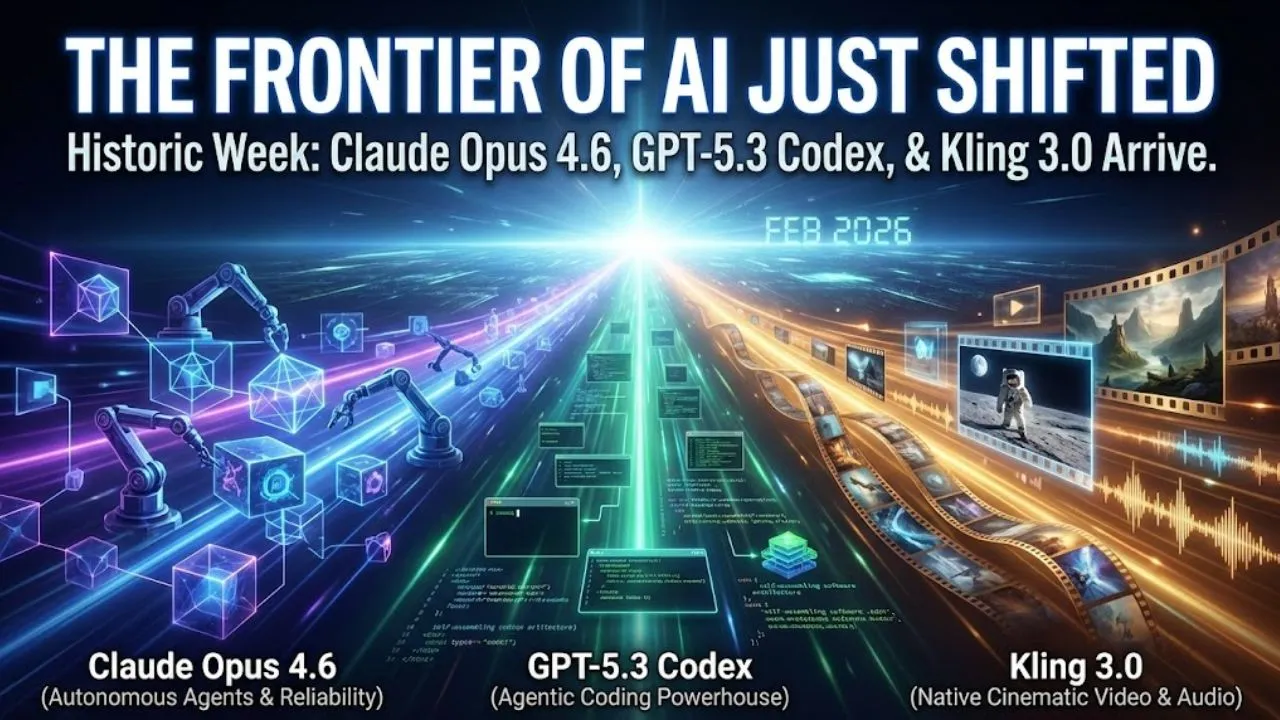
In the fast-moving world of artificial intelligence, some weeks feel like historical inflection points. The first week of February 2026 was exactly that. Within roughly 20 minutes of each other, Anthropic launched Claude Opus 4.6 and OpenAI dropped GPT-5.3 Codex. Hours later, the Chinese video-generation model Kling 3.0 began dominating creator feeds and showcase reels.
These three releases — dissected at length by Gavin Purcell and Kevin Pereira on the AI for Humans podcast — clearly show the frontier moving toward more autonomous, longer-horizon, multi-agent, and multimodal systems.
1. Claude Opus 4.6 – Anthropic’s Most Capable & Reliable Agent Model Yet
Anthropic positioned Opus 4.6 as their new flagship for complex software engineering, long-running research agents, and enterprise knowledge work.
Major Upgrades
- Native agent-team orchestration — multiple specialized sub-agents collaborating in parallel
- Adaptive thinking depth — model decides how long/often to reason (no manual toggle needed)
- 1 million token context window (beta)
- Leads or near-leads on Terminal-Bench 2.0, BrowseComp, Humanity’s Last Exam, GDPval-AA, and several new agentic coding & computer-use leaderboards
- Noticeably stronger self-correction and debugging behavior during long sessions
Real-world anecdotes Podcast hosts reported dramatic one-shot fixes on bugs that had previously taken 15–30 minutes of back-and-forth with Opus 4.5. The model is already live on claude.ai, Claude API, Cursor, GitHub Copilot, Vertex AI, and OpenRouter.
2. GPT-5.3 Codex – OpenAI’s Purpose-Built Agentic Coding Powerhouse
OpenAI responded almost instantly with GPT-5.3 Codex — a coding-specialized frontier model that appears to blend the best reasoning of GPT-5 family with dramatically improved tool use and autonomy.
Standout Characteristics
- ~25% faster inference and meaningfully lower token usage on many agentic tasks
- First public demonstration of OpenAI using the model to improve parts of its own toolchain (early recursive self-improvement signal)
- Brand-new Codex macOS app — clean, natural-language-first coding environment similar in spirit to Claude’s co-work / artifacts interface
- Very strong performance on long-horizon software-engineering benchmarks (reportedly beating Opus 4.6 by a clear margin on several)
Developer experience Early testers describe it as more “obedient” and consistent than Opus 4.6 for day-to-day fixing / feature-adding workflows, while Opus sometimes shows higher peak capability on extremely open-ended projects.
3. Kling 3.0 – Native Multimodal Video + Audio Generation Reaches New Realism
While text frontier models stole the spotlight, Kling 3.0 (Kuaishou) quietly became the new benchmark for consumer-accessible cinematic video.
Why creators are buzzing
- Native 4K video + synchronized character dialogue + lip-sync
- Multi-shot story coherence and cinematic camera movement
- Strong reference-image and reference-video control for character consistency
- Early showcase videos (fake moon-landing docu-style pieces, fantasy novel scenes) already look broadcast/television quality in skilled hands
Prompting still requires care and iteration — it is not yet a “type once, perfect first try” tool — but the ceiling is clearly among the highest available today.
Quick Hits – Other Notable Releases & Signals This Week
- Figma AI vector conversion — raster → fully editable vector in seconds
- Grok Imagine 1.0 official launch
- Roblox in-game 3D asset creation via text prompt
- Unitree quadruped robot completing 130,000+ steps in extreme cold
- Continued buzz around OpenClaw / local agent tooling and “rent-a-human” meme economy
Bottom Line – 2026 Is Accelerating
This week crystallized several macro trends:
- Agent orchestration & multi-agent collaboration moving from research → production
- Models visibly contributing to their own tooling / improvement loops
- Video + audio + reasoning unification lowering the bar for solo “filmmaking”
- Brutal public competition (benchmark jousting, timing of releases, Super Bowl ad-level shade)
Podcast takeaway (paraphrased): “Use these tools now. The gap between people who know how to wield frontier models and people who don’t is widening very quickly.”
Whether you’re debugging production code, automating enterprise workflows, or directing your first AI-generated short film — the models released this week hand you superpowers that felt like science fiction just months ago.
The only real question is how fast you start using them.
Disclaimer: This article is based on the February 2026 episode of the AI for Humans podcast and summarizes the hosts’ real-time reactions, user anecdotes, and reported benchmark/performance claims. As of the recording date (early February 2026), Claude Opus 4.6 and GPT-5.3 Codex were very newly released or in very early access. Some capabilities (especially long-running agent teams, recursive self-improvement, and exact benchmark scores) are based on early user reports, company announcements, and podcast discussion — not independent long-term verification. AI model names, versions, and features can change rapidly. Always check official sources (anthropic.com, openai.com, kling.ai, etc.) for the latest availability, pricing, access, and safety information. This is not financial, investment, or technical advice.