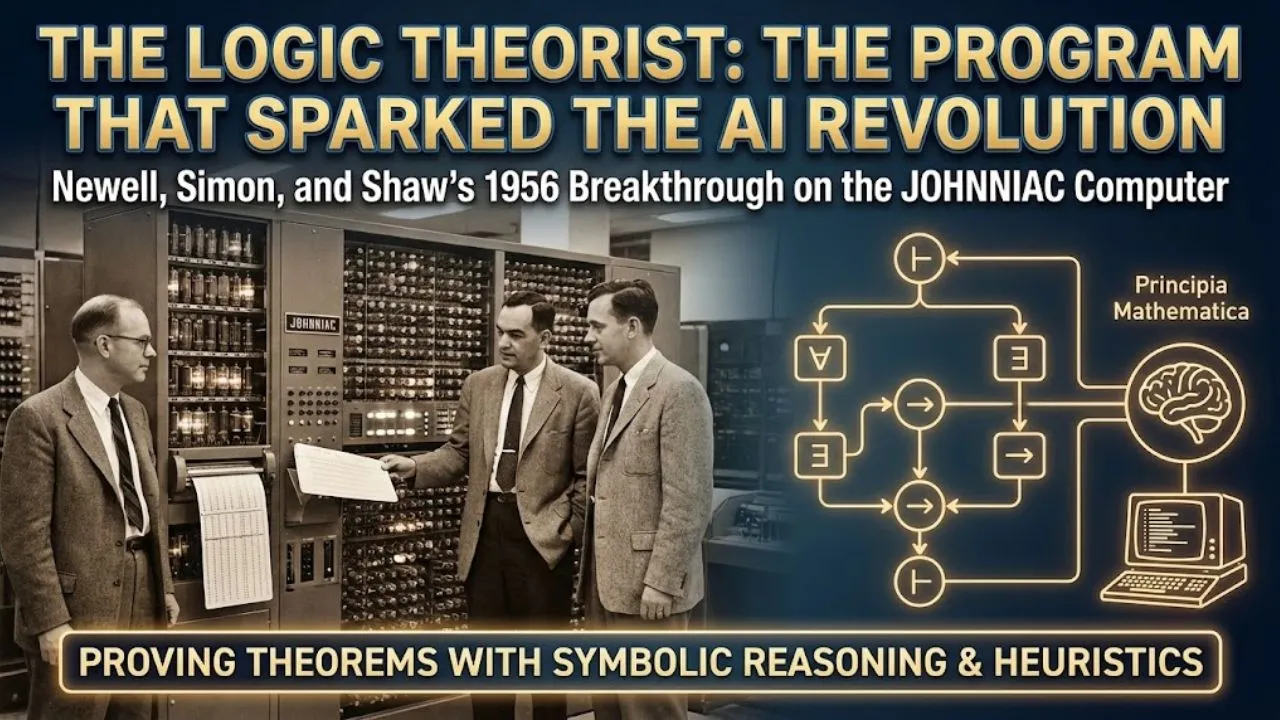
Ever wondered where artificial intelligence truly began? While modern AI powers chatbots, image generators, and self-driving cars, the story starts much earlier—in the mid-1950s—with a program called the Logic Theorist. Widely regarded as the first deliberately engineered AI program, it proved machines could simulate human-like reasoning and problem-solving. Developed by Allen Newell, Herbert A. Simon, and J.C. Shaw, this groundbreaking system not only marked the birth of practical AI but also set the stage for decades of research.
Origins and Development (1955–1956)
In 1955, the field of artificial intelligence didn’t even have a name yet. Newell and Simon, working at the RAND Corporation in Santa Monica, California, set out to test whether computers could mimic human problem-solving. Inspired by the symbolic logic in Bertrand Russell and Alfred North Whitehead’s Principia Mathematica (1910–1913), they aimed to build a program that could prove mathematical theorems automatically.
Joined by programmer J.C. Shaw, they created the Logic Theorist (often abbreviated LT). The program used:
- Symbolic representation of logical statements.
- Heuristic search — a tree-search method with clever shortcuts (“heuristics”) to prune unlikely paths and focus on promising ones.
- Means-ends analysis — breaking problems into sub-goals, much like how humans tackle complex puzzles.
This was revolutionary: it introduced heuristics to computing, allowing the system to efficiently explore vast possibility spaces instead of brute-forcing every option.
The program was written in what became the Information Processing Language (IPL), one of the earliest list-processing languages designed for symbolic manipulation.
The Historic Demonstration at Dartmouth (1956)
The Logic Theorist made its public debut at the famous Dartmouth Summer Research Project on Artificial Intelligence in the summer of 1956—the event where John McCarthy officially coined the term “artificial intelligence.”
Newell and Simon brought punch cards containing the program. It ran on the JOHNNIAC computer (named after John von Neumann), a custom-built machine at RAND inspired by the IAS architecture. JOHNNIAC used Selectron tubes for main memory (later upgraded to magnetic-core) and delay-line memory (acoustic waves in mercury-filled tubes to store bits as sound pulses—a quirky, pre-semiconductor tech that was cutting-edge but slow and limited by today’s standards).
During the conference, the Logic Theorist proved 38 of the first 52 theorems in Chapter 2 of Principia Mathematica. Even more impressively, for Theorem 2.85, it discovered a shorter, more elegant proof than the one in the original book—something Whitehead and Russell hadn’t found.
This wasn’t just computation; it hinted that machines could potentially outperform humans in creative reasoning within narrow domains.
Impact and Legacy
The Logic Theorist’s success was monumental:
- It validated the idea that intelligence could be modeled as symbolic manipulation and search.
- It directly led to the General Problem Solver (GPS) in 1957–1959, an attempt at a more universal problem-solving system.
- Newell and Simon’s work influenced cognitive science, the cognitive revolution, and early expert systems.
- Heuristics and tree-search techniques remain foundational in modern AI—from game-playing algorithms (like alpha-beta pruning in chess engines) to pathfinding in robotics and even parts of machine learning optimization.
Newell and Simon later won the Turing Award (1975) for these contributions, and their unified theory of cognition (Soar architecture) built directly on these early ideas.
Read Also: How to Use Rent a Human AI – A Complete Guide
Was There Anything Earlier?
While the Logic Theorist is almost universally called the first true AI program (designed explicitly to simulate intelligent behavior), some earlier efforts laid groundwork:
- 1940s–1950s: Claude Shannon’s chess-playing algorithms (1950) and Arthur Samuel’s checkers program (1952–1959) used learning and search but were more game-specific than general reasoning.
- 1950: Alan Turing’s “Computing Machinery and Intelligence” paper proposed the Turing Test and explored machine intelligence conceptually—no running program, though.
- No full symbolic reasoning program predates Logic Theorist in the way it deliberately mimicked human theorem-proving.
Final Thoughts
The Logic Theorist and its humble home on the JOHNNIAC weren’t flashy by 2026 standards—no GPUs, no neural nets, just vacuum tubes, punch cards, and mercury tubes humming with sound waves. Yet they proved a profound point: machines could reason, discover, and even improve on human work in logic.
From that 1956 Dartmouth demo to today’s frontier models, AI’s journey started with a simple question: Can a machine think like a human? The Logic Theorist gave the first resounding “yes”—in symbols, search, and elegant proofs.
What do you think—was there an even earlier “AI” hidden in history? Drop your thoughts in the comments!
Disclaimer: This article draws from historical accounts, including Wikipedia, Carnegie Mellon University archives, RAND Corporation reports, and AI history sources (e.g., McCorduck’s Machines Who Think, 2004; various 2023–2025 retrospectives). Dates, achievements, and technical details are based on established records; minor variations exist in secondary sources. For primary documents, refer to Newell & Simon’s original papers or the Dartmouth Conference proceedings.